Adenomyosis is a chronic disease characterized by growth of endometrial tissue within the myometrium due to nonmalignant hyperplasia of the endometrial basal layer. Adenomyosis affects individuals of reproductive age; the etiology is unknown, but it often coexists with conditions such as endometriosis and uterine fibroids. Symptoms include dysmenorrhea, abnormal uterine bleeding, chronic pelvic pain, and infertility. A globular, uniformly enlarged uterus may be detected on pelvic examination. Transvaginal ultrasound is the preferred initial test to evaluate for adenomyosis. Treatment consists of NSAIDs and hormonal contraception to relieve pain and other symptoms. For patients with refractory symptoms or who are trying to conceive, referral to a specialist for consideration of invasive treatment or medical therapy with GnRH agonists or GnRH antagonists is recommended.
Peak incidence at 40–50 years
Epidemiological data refers to the US, unless otherwise specified.
The exact etiology is unknown, although adenomyosis often occurs in patients with: [1][2]
- Endometriosis
- Uterine fibroids
- Endometrial polyps
- A history of:
- Uterine surgery (including cesarean delivery)
- Multiparity
-
Symptoms: present in two-thirds of patients [2]
- Abnormal uterine bleeding (AUB)
- Dysmenorrhea
- Chronic pelvic pain that is aggravated during menses
- Dyspareunia
- Infertility [1]
- Pelvic examination: soft (boggy), uniformly enlarged, globular uterus that may be tender on palpation [2][3]
Adenomyosis is asymptomatic in up to one-third of patients. [1]
Adenomyosis is typically diagnosed based on clinical features and imaging studies. While histological examination of excised tissue (e.g., after hysterectomy or excision) provides a definitive diagnosis, surgery is not performed solely to confirm the diagnosis. [1][3][4]
Initial studies
Consider starting treatment for adenomyosis before confirming the diagnosis. [1][2]
Imaging
-
Transvaginal ultrasound (TVUS) [5]
- Test of choice for initial imaging of the uterus
- Findings include: [3]
- Heterogeneous myometrium
- Asymmetric myometrial thickening
- Myometrial cysts
- Subendometrial echogenic linear striations
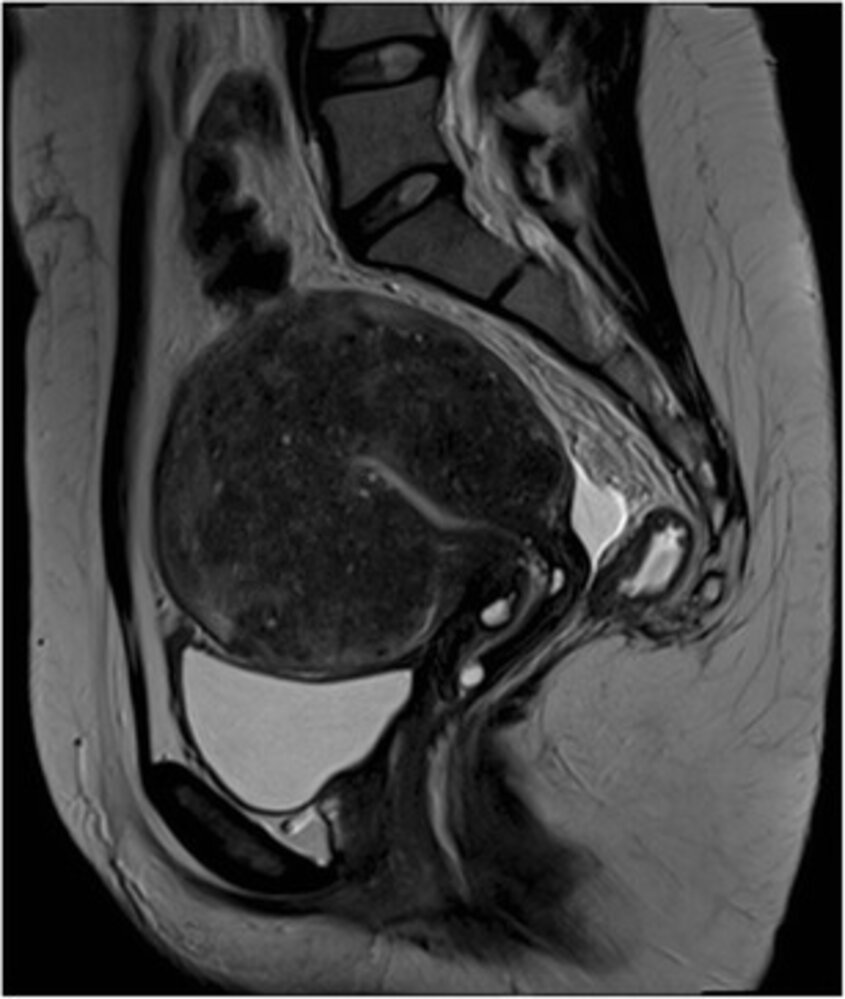
- Obtain MRI pelvis with and without IV contrast if: [2][5][6]
- TVUS results are inconclusive
- The uterus cannot be completely visualized with TVUS
- Surgery is planned
Additional diagnostic studies
Additional studies depend on clinical features and may include:
- Diagnostics for AUB
- Diagnostics for infertility
Advanced diagnostic studies
Advanced diagnostic studies are not routinely performed but may be considered by a gynecologist.
-
Hysteroscopy [4]
- Used in diagnostic uncertainty [1]
- Findings include hypervascularization, submucosal hemorrhagic cysts, and endometrial defects. [1]
-
Histology of excised tissue [4]
- Provides a definitive diagnosis [2]
- Consider if the patient is undergoing surgical treatment for suspected adenomyosis.

- Differential diagnoses of vaginal bleeding
- Causes of AUB
- Causes of pelvic pain
- Common causes of dysmenorrhea
The differential diagnoses listed here are not exhaustive.
Treatment of adenomyosis is primarily symptom-based; see also “Treatment of abnormal uterine bleeding.”
Approach [1][2]
- Identify and treat:
- Complications of adenomyosis
- Common comorbid conditions (e.g., endometriosis)
- Start initial therapy for symptom relief. [1][2]
- Refer patients to gynecology to evaluate for advanced treatments if they:
- Are trying to conceive
- Are unable to tolerate initial therapy
- Have refractory symptoms despite initial medical therapy
Initial therapy [1][2]
- Combined oral contraceptives (off-label)
- Progestin-only contraceptive pills, e.g., high-dose norethindrone (off-label) [2]
- Progestin intrauterine device (off-label)
- NSAIDs for pain relief, e.g., ibuprofen (for dosages, see “Oral analgesia”) [2]
Advanced treatments
- Medical therapy: GnRH agonists (off-label) and GnRH antagonists (off-label) [2]
-
Invasive treatments for adenomyosis [1][2]
- Fertility-sparing procedures (e.g., adenomyomectomy, uterine wedge resection)
- Fertility-compromising procedures (e.g., endometrial ablation, uterine artery embolization, hysterectomy)
- Anemia
- Infertility
- Obstetric complications, e.g.: [2]
- Preeclampsia
- Preterm birth
- Small for gestational age
We list the most important complications. The selection is not exhaustive.