Guest Mode
AMBOSS Articles/ Pharmacology > Gastrointestinal

Antiemetics

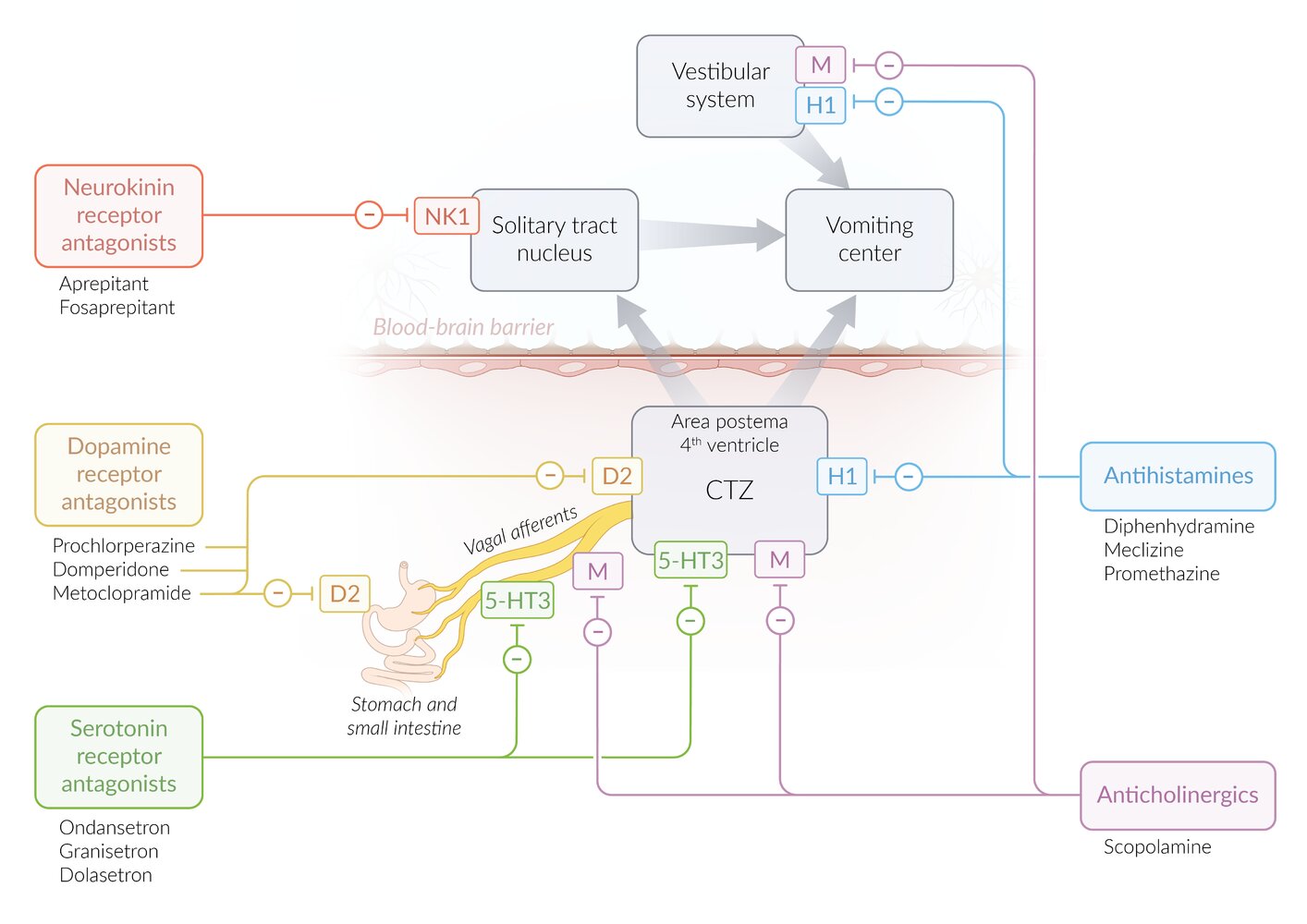
Antiemetics are a heterogeneous group of drugs used to treat various causes of nausea and vomiting. Different antiemetics act on different receptors, and they may have a peripheral effect, a central effect, or both. Whereas serotonin antagonists, for example, bind 5-HT3 receptors and effectively combat cytotoxic drug nausea, certain anticholinergic drugs target M1 receptors and specifically treat motion sickness (kinetosis). Hospitals and clinics commonly use the dopamine D2 antagonist metoclopramide. However, because of its strong central effect and possible extrapyramidal side effects, metoclopramide must be used with caution.

Antiemetics in adults

Overview of antiemetics in adults
Antiemetic class Drug Mechanism of action Clinical use Side effects
Dopamine receptor antagonists
  • Prochlorperazine [1]
  • D2 antagonist
  • Central antiemetic effect at the area postrema
  • Antipsychotic agent
  • Hyperemesis gravidarum
  • Gastrointestinal
    • Diarrhea
    • Pain
  • Hyperprolactinemia
  • Neurological
    • Depression, anxiety
    • Fatigue
    • Drowsiness
    • Restlessness
    • Lowering of seizure threshold
    • Overdose leads to reversible extrapyramidal syndrome (e.g., dystonia, parkinsonism, tardive dyskinesia, and akathisia) and neuroleptic malignant syndrome
    • Do not combine metoclopramide with antipsychotics because this increases the risk of dyskinesia!
    • Antidote: benztropine, biperiden (anticholinergic agents)
  • Avoid combination with digoxin and antidiabetic drugs.
  • Contraindicated in patients with suspected small bowel obstruction
  • Metoclopramide [2]
  • D2 antagonist, serotonin receptor antagonist
  • Central antiemetic effect at the area postrema
  • Peripheral antiemetic effect in the gastrointestinal tract (prokinetic effect); causes increase in :
    • Gastric contractions
    • Duodenal and jejunal motility
    • Resting tone of the lower esophageal sphincter
  • Together with decreased pylorus sphincter activity allows food to pass more quickly through the stomach and the small intestine
  • No influence on colon motility
  • Prokinetic effect used to treat diabetic and postsurgery gastroparesis (delayed gastric emptying)
  • Hyperemesis gravidarum
  • Persistent GERD
  • Domperidone
  • D2 antagonist
  • Central antiemetic effect at the area postrema
  • Prokinetic effect (due to blockage of peripheral dopamine receptors)
  • Nausea and vomiting
  • Gastrointestinal motility disorders
  • Gastrointestinal
    • Diarrhea
    • Pain
  • Hyperprolactinema
  • Domperidone, in contrast to metoclopramide and prochlorperazine, crosses the blood-brain-barrier only minimally, hence neurological side effects are limited
  • May cause cardiac arrhythmias
Serotonin receptor antagonists (5-HT3 antagonists)
  • Ondansetron [3]
  • Granisetron
  • Dolasetron
  • Palonosetron
  • 5-HT3antagonist
  • Strong central antiemetic effect at the area postrema
  • Peripheral antiemetic effect via inhibition of the vagus nerve
  • Ondansetron is commonly used for generalized nausea.
  • Chemotherapy-induced vomiting, radiation-induced vomiting, and postoperative nausea and vomiting (PONV)
  • Headaches
  • Constipation or diarrhea
  • QT interval prolongation (torsades de pointes)
  • Increase in liver enzymes
  • Serotonin syndrome
Anticholinergic agents [4]
  • Scopolamine
  • Nonspecific muscarinic antagonist
  • Central antiemetic effect at the area postrema and on the vestibular system
  • Peripheral antiemetic effect via inhibition of the vagus nerve
  • Motion sickness, vestibular-induced nausea, and vomiting
  • Anticholinergic side effects: dry mouth, mydriasis, tachycardia, urinary retention
  • Antidote: physostigmine (cholinesterase inhibitor)
Antihistamines
  • Meclizine
  • Dimenhydrinate
  • Diphenhydramine
  • Doxylamine
  • Promethazine
  • H1 antagonist
  • Central antiemetic effect at the area postrema and vestibular system
  • Strong sedative
  • Nausea and vomiting due to vestibular causes [5]
  • Hyperemesis gravidarum (also see antiemetics during pregnancy)
  • Antihistamine effects: drowsiness and confusion
  • Anticholinergic side effects: dry mouth, dilated pupils, blurred vision, reduced bowel sounds, and urinary retention (antidote: physostigmine)
Neurokinin receptor antagonists
  • Aprepitant
  • Fosaprepitant
  • NK1 antagonist
  • Inhibition of NK1receptors in the solitary nucleus and area postrema → central antiemetic effect [6]
  • Additional inhibition of substance P-induced vomiting due to antagonism
  • CINV prophylaxis
  • Gastrointestinal: diarrhea
  • Fatigue
  • Hypersensitivity reactions
  • Infusion site reactions
  • Increased levels of other drugs due to weak CYP3A4 enzyme inhibition
Glucocorticoids
  • Dexamethasone
  • Methylprednisolone
  • Exact mechanism unknown
  • Central antiemetic effect possibly mediated by interaction with glucocorticoid receptors in the solitary nucleus [7]
  • Dexamethasone
    • CINV prophylaxis
    • PONV prophylaxis
    • PONV treatment
  • Methylprednisolone: hyperemesis gravidarum
  • Cushing syndrome
  • Hyperglycemia
Benzodiazepines [8][9]
  • Lorazepam
  • GABA agonist
  • Central antiemetic effect likely due to depression of the chemotrigger zone [9]
  • CINV prophylaxis
  • CINV treatment
  • Sedation
  • Drowsiness, confusion
  • Ataxia
  • Dizziness
  • Anterograde amnesia
  • Can raise IOP and trigger angle-closure glaucoma.
  • Respiratory depression
Atypical antipsychotics [8][9][10][11]
  • Olanzapine
  • Central antiemetic effect via inhibition of multiple neurotransmitters (e.g., dopamine, serotonin, histamine)
  • CINV prophylaxis
  • CINV treatment
  • Sedation
  • Weight gain
  • Diabetes mellitus (prolonged use)
  • Hypertriglyceridemia, hypercholesterolemia
  • Extrapyramidal adverse effects
  • QT interval prolongation
Cannabinoids [8][12][13]
  • Dronabinol solution
  • Dronabinol capsules
  • Nabilone
  • Cannabinoid (CB1 and CB2) agonists
  • Central antiemetic effect: CB1 agonism in the brain stem suppresses the emetic reflex.
  • Peripheral antiemetic effect: CB2 agonism in the gastrointestinal tract inhibits gastrointestinal motility.
  • CINV treatment
  • Anorexia causing weight loss in patients with advanced HIV
  • Ataxia, dizziness, dry mouth
  • Euphoria, dysphoria
  • Paranoia, hallucinations
  • Abdominal pain
  • Paradoxical worsening of nausea and vomiting (cannabinoid hyperemesis syndrome)

Antiemetics in children [14]

  • Ondansetron is commonly used for nausea and vomiting in children, e.g.:
    • Acute gastroenteritis with dehydration in ER settings: PO ondansetron (off-label) [15][16][17]
    • GI emergencies
      • IV ondansetron (off-label) [16]
      • PO ondansetron (off-label) [16]
    • Chemotherapy-induced nausea and vomiting (CINV): The dosage and route vary by indication; consult a specialist.
    • Postoperative nausea and vomiting prevention: ondansetron
  • Alternative agents may be used for specific indications; consult a specialist.
    • Motion sickness or vertigo: e.g., diphenhydramine (off-label) , dimenhydrinate [18]
    • Migraine: e.g., prochlorperazine, metoclopramide [19]
    • CINV: e.g., dexamethasone, neurokinin receptor antagonist [20]
  • Nonspecific nausea and vomiting
  • Chemotherapy-induced nausea and vomiting
  • Vertigo (e.g., vestibular neuritis, Ménière's disease)
  • Motion sickness
  • Gastrointestinal motility disorder (e.g., due to diabetic gastroparesis)
  • Postoperative nausea and vomiting

References:[21]

  • Dopamine receptor antagonists
    • Intestinal obstruction (ileus)
    • Prolactin-dependent tumors
    • Parkinson disease: unlike domperidone, metoclopramide and prochlorperazine can cross the blood-brain barrier and exacerbate the pre-existing dopamine deficiency that causes parkinsonism.
  • Serotonin receptor antagonists: : severe liver disease, prolonged QT interval
  • Anticholinergic agents and antihistamines
    • Tachyarrhythmias, heart failure
    • Urinary retention, BPH
    • Glaucoma
    • Pyloric stenosis

References:[21]

We list the most important contraindications. The selection is not exhaustive.