The brainstem is the caudal part of the brain and consists of the midbrain, pons, and medulla oblongata. The brainstem regulates autonomic functions (respiration, circulation, lacrimation, salivation), controls visual and auditory reflexes, and maintains vigilance. It is also a hub through which run all ascending sensory pathways, descending motor pathways, and other local pathways of the central nervous system.
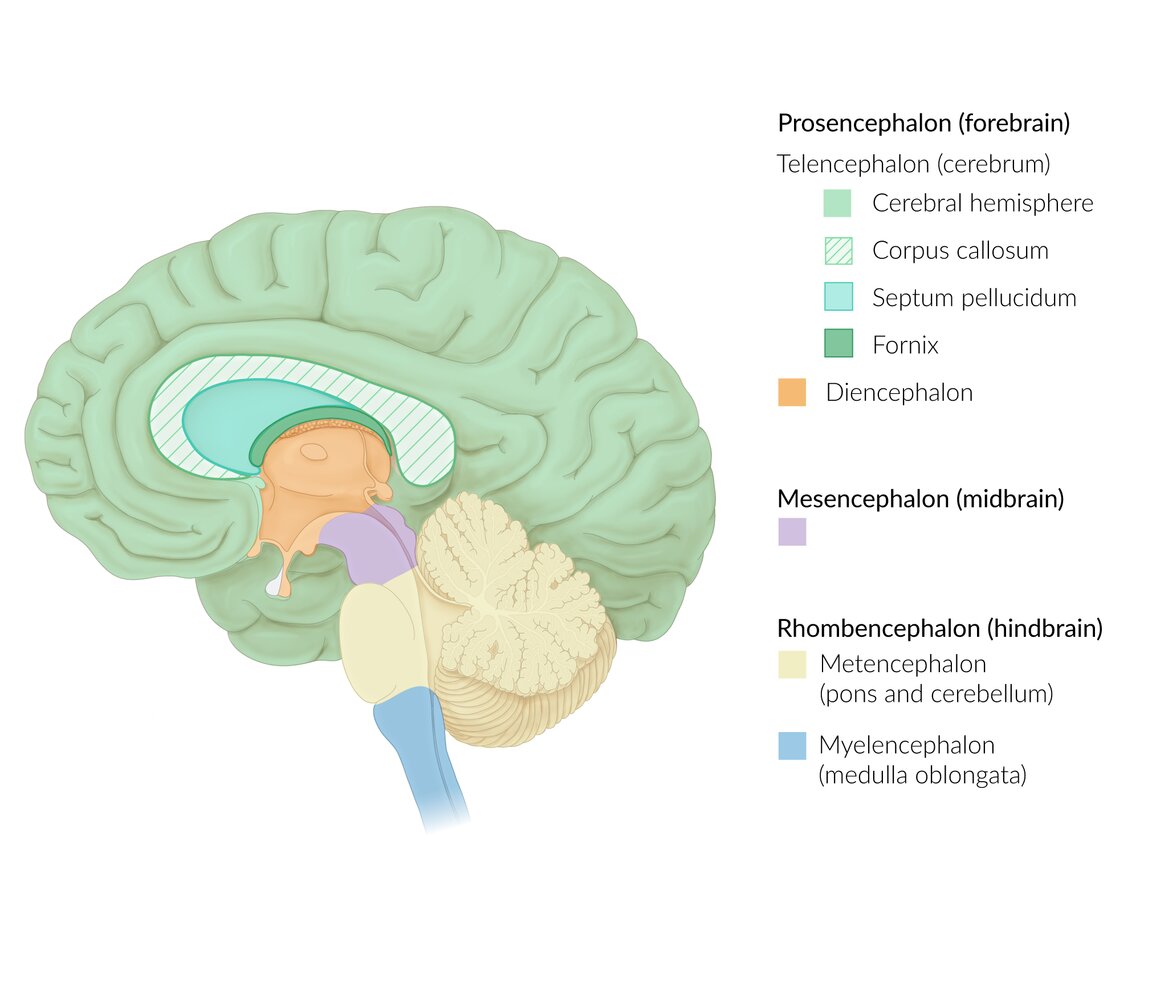
Embryogenesis
-
Mesencephalon → midbrain
-
Rhombencephalon
-
Metencephalon → pons and cerebellum
-
Myelencephalon → medulla oblongata
Composition
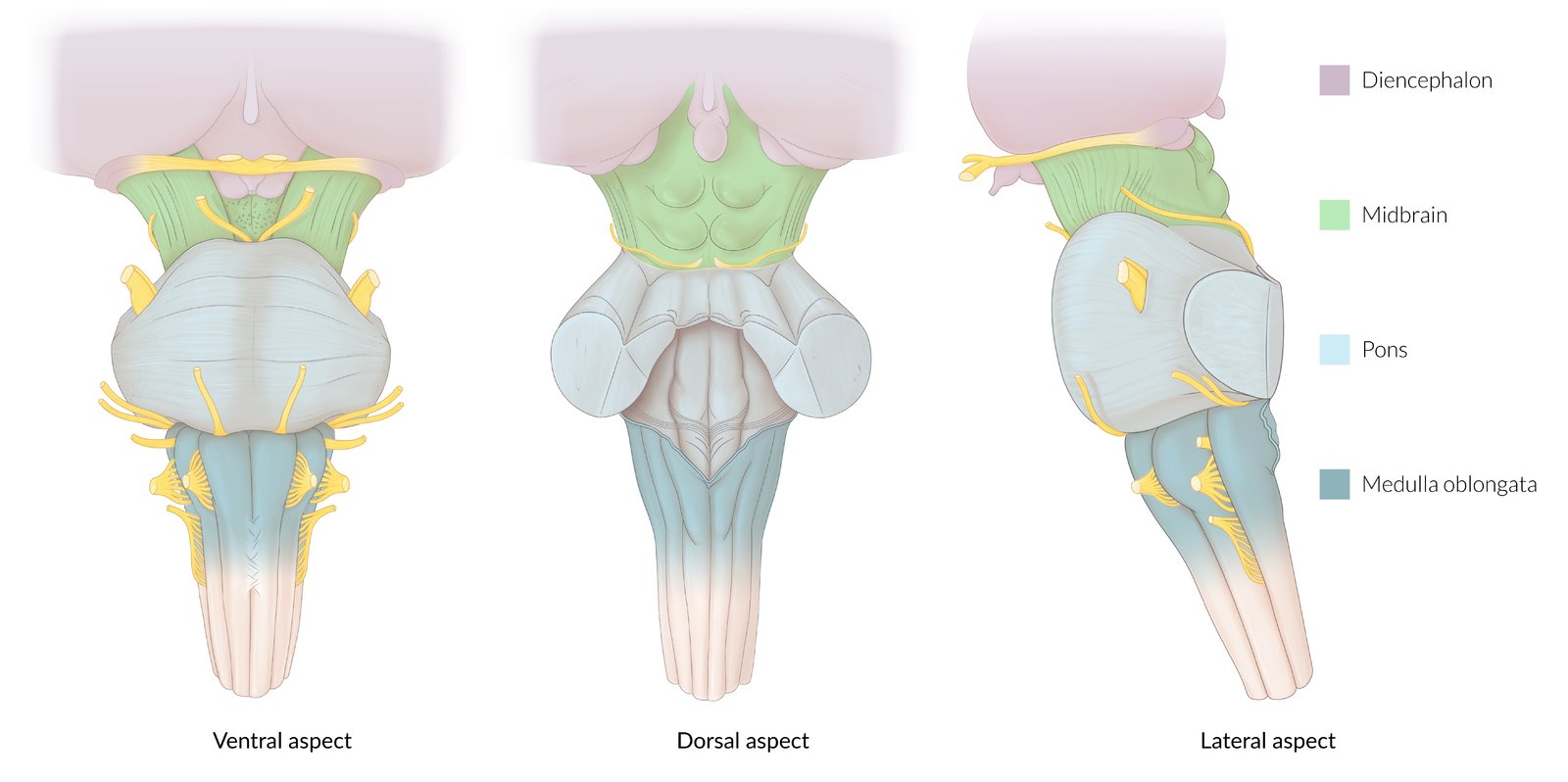
- Parts (superior to inferior):
- Midbrain
- Pons
- Medulla oblongata
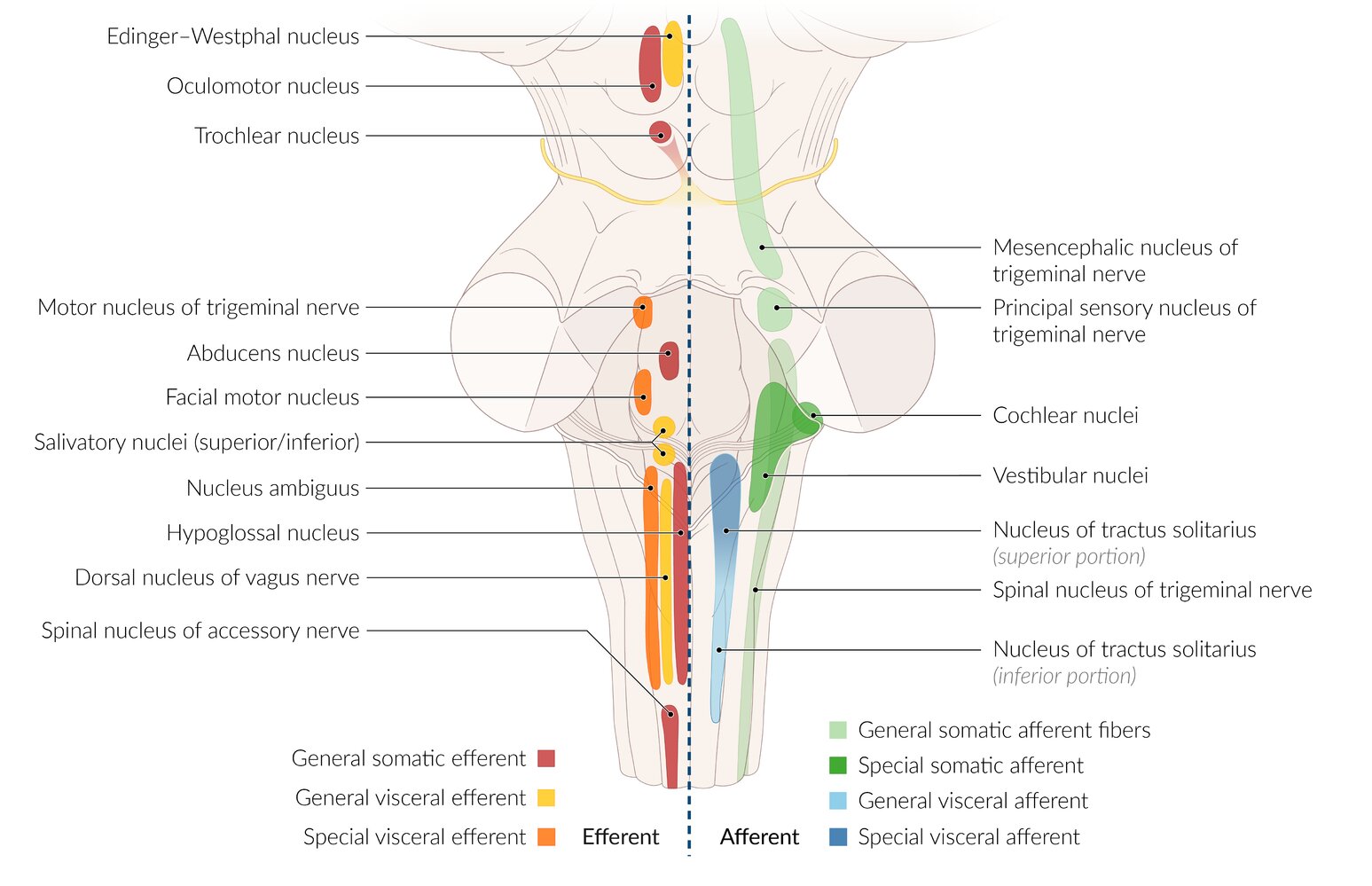
- Nuclei of CN III–XII
- Major ascending (sensory) and descending (motor) pathways
- Reticular formation (responsible for alertness)
|
Overview of brainstem anatomy [1][2]
|
|---|
|
Medial |
Lateral |
| Midbrain |
|---|
| Blood supply |
- Ipsilateral posterior cerebral artery
- Basilar artery
|
- Ipsilateral posterior cerebral artery
|
| Important structures |
- Motor pathway (corticospinal tract)
- Medial lemniscus
- Medial longitudinal fasciculus
- Motor nuclei: CN III and IV nuclei
|
- Spinocerebellar pathway
- Spinothalamic tract
-
Sympathetic pathway
|
| Pons |
|---|
| Blood supply |
- Paramedian branches of the basilar artery
|
- Ispilateral anterior inferior cerebellar artery
- Circumferential branches of the basilar artery
|
| Important structures |
- Motor pathway (corticospinal tract)
- Medial lemniscus
- Medial longitudinal fasciculus
- Motor nucleus: CN VI nucleus
|
- Spinocerebellar pathway
- Spinothalamic tract
-
Sympathetic pathway
-
CN V, CN VII, and VIII nuclei
|
| Medulla oblongata |
|---|
| Blood supply |
- Basilar artery
- Anterior spinal artery
- Paramedian branches of the ipsilateral vertebral artery
|
- Ipsilateral posterior inferior cerebellar artery
- Lateral branches of the ipsilateral vertebral artery
|
| Important structures |
- Motor pathway (corticospinal tract)
- Medial lemniscus
- Medial longitudinal fasciculus
- Motor nucleus: CN XII nucleus
|
- Spinocerebellar pathway
- Spinothalamic tract
-
Sympathetic pathway
-
CN IX, X, and XI nuclei, and the spinal nucleus of CN V
|
|
Rule 2: Four factors of 12 except 1 and 2 are purely motor nuclei (CN III, IV, VI and XII). To localize brainstem strokes, remember the four rules of four. Rule 1: Four nuclei are below the pons (CN IX–XII in the medulla), four are in the pons (CN V–VIII), and four are above the pons (CN III and IV in the midbrain, CN I and II originate from the cerebrum). Rule 3: Four structures beginning with M are located in the middle: purely Motor nuclei, Motor pathway (corticospinal tract), Medial lemniscus (proprioception and vibration in the trunk and extremities), and Medial longitudinal fasciculus (coordinating eye movements). Rule 4: Four structures beginning with S are located to the side: Spinocerebellar pathway, Spinothalamic tract (pain and temperature in the trunk and extremities), Spinal sensory nucleus of CN V (pain and temperature sensation in the face), and Sympathetic pathway.
|
|---|

Function
- Regulation of awareness and sleep cycle
- Regulation of autonomic functions (e.g., circulation, respiration, gastrointestinal activity, salivation, lacrimation)
- Conduction
- Ascending sensory tracts via cranial nerves (face) and spinal cord (rest of the body)
- Descending motor tracts from forebrain and cerebellum to neck and face (via cranial nerves) and the rest of the body (via spinal cord)
- Local pathways (e.g., visual and auditory reflexes)
Characteristics
-
Location: rostral to the pons, ventral to the cerebellum, caudal to the thalamus
-
Function
- Processing of auditory and visual information
- Coordination of eye movement
- Modulation of extrapyramidal motor function
- Conduction of fiber tracts
- Nociception
- Arousal and alertness
-
Composition: three main components
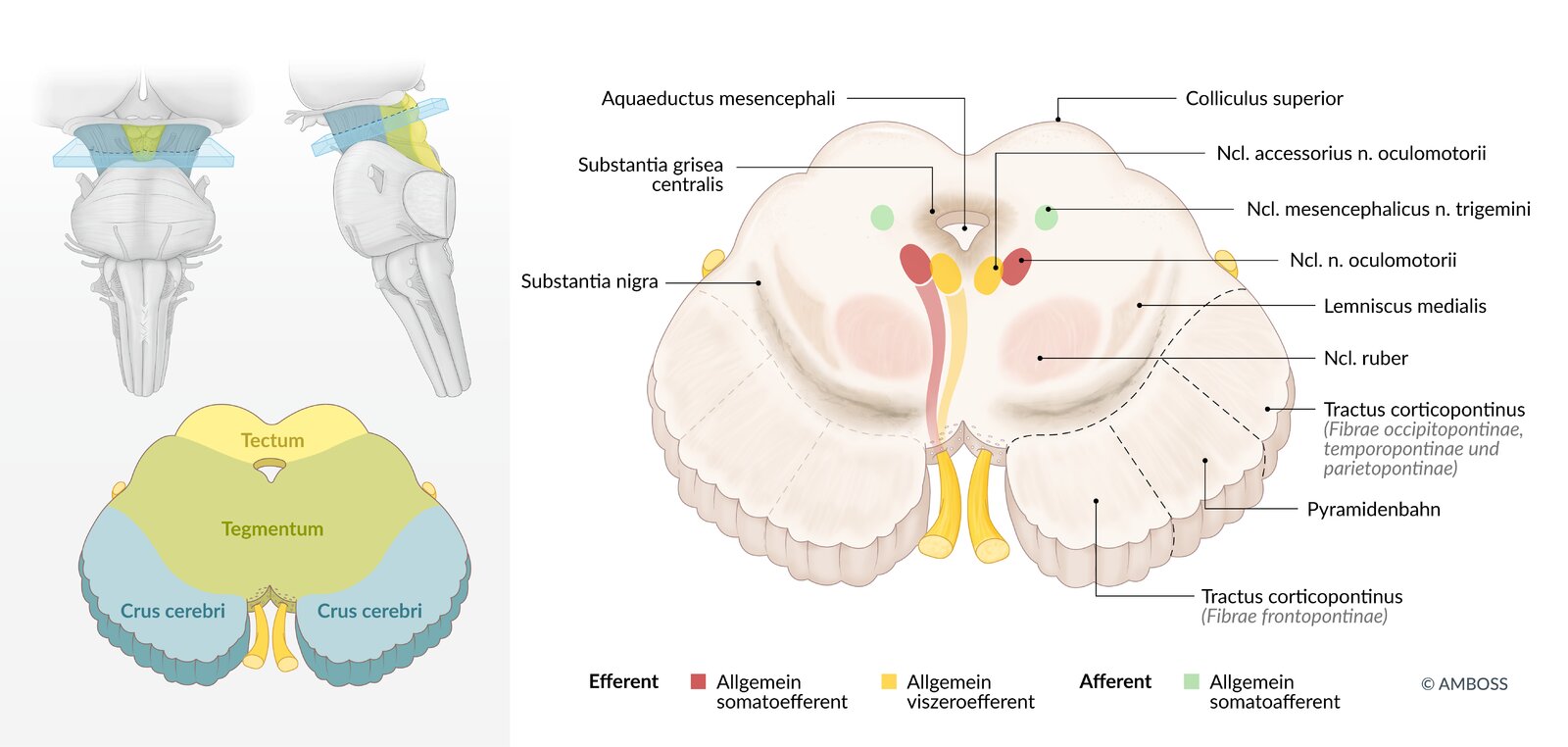
- Crura cerebri
- Tegmentum
- Tectum
-
Embryogenesis: derived from mesencephalon
Components of the midbrain
| Overview of the midbrain |
|---|
| Structure |
Location |
Components |
Function/Characteristics |
|
Tectum
|
- Posterior to the cerebral aqueduct
- Forms the roof of the midbrain
|
|
- Relay voluntary and involuntary eye movements (e.g., saccades)
- Facilitate optic reflexes
- Receive input from the retina and the pretectal area
- Project to the lateral geniculate bodies
|
|
- Part of the auditory pathway
- Receive input from the lateral lemniscus
- Project to the medial geniculate bodies
|
|
Tegmentum
|
- Extends from midbrain to pons
- Between the tectum and the base of the midbrain
|
- Sensory pathways and nuclei of oculomotor nerve (CN III) and trochlear nerve (CN IV)
- Mesencephalic nucleus of trigeminal nerve (CN V)
- Substantia nigra (see below)
- Red nucleus (see below)
|
- Involved in modulation of extrapyramidal motor function
|
|
Substantia nigra
|
|
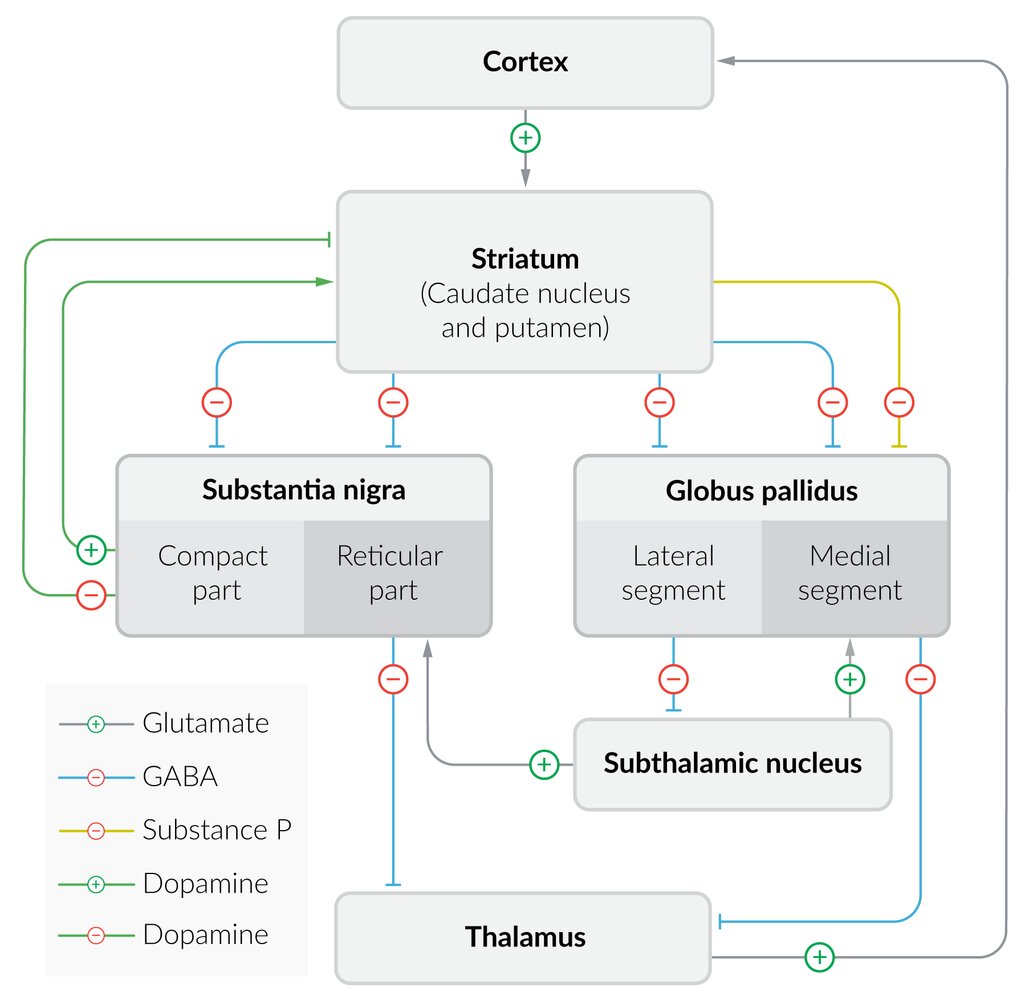
- Pars compacta: contains dopaminergic neurons with high levels of melanin
- Pars reticularis: contains mainly GABAergic neurons
|
-
Involved in initiating and coordinating movements
- Receives inhibitory input (GABA) from the striatum
- Projects dopaminergic fibers to the striatum (↑ motor function)
- Projects GABAergic fibers to motoric nuclei (e.g., ventral lateral, ventral anterior) of the thalamus (↓ motor function)
- For more information on the basal ganglia, see also “Basal ganglia” in “The cerebral cortex, meninges, basal ganglia, and ventricular system.”
- For information on associated disorders, see “Parkinson disease” and “Parkinson-plus syndromes.”
|
|
Red nucleus
|
- Within the tegmentum, at the level of the oculomotor nerve nucleus
|
-
Caudal magnocellular part
-
Rostral parvocellular part
|
- Coordination of movement and gait
- Preservation of muscular tone
- Receives and relays input from the cerebral cortex and the cerebellum
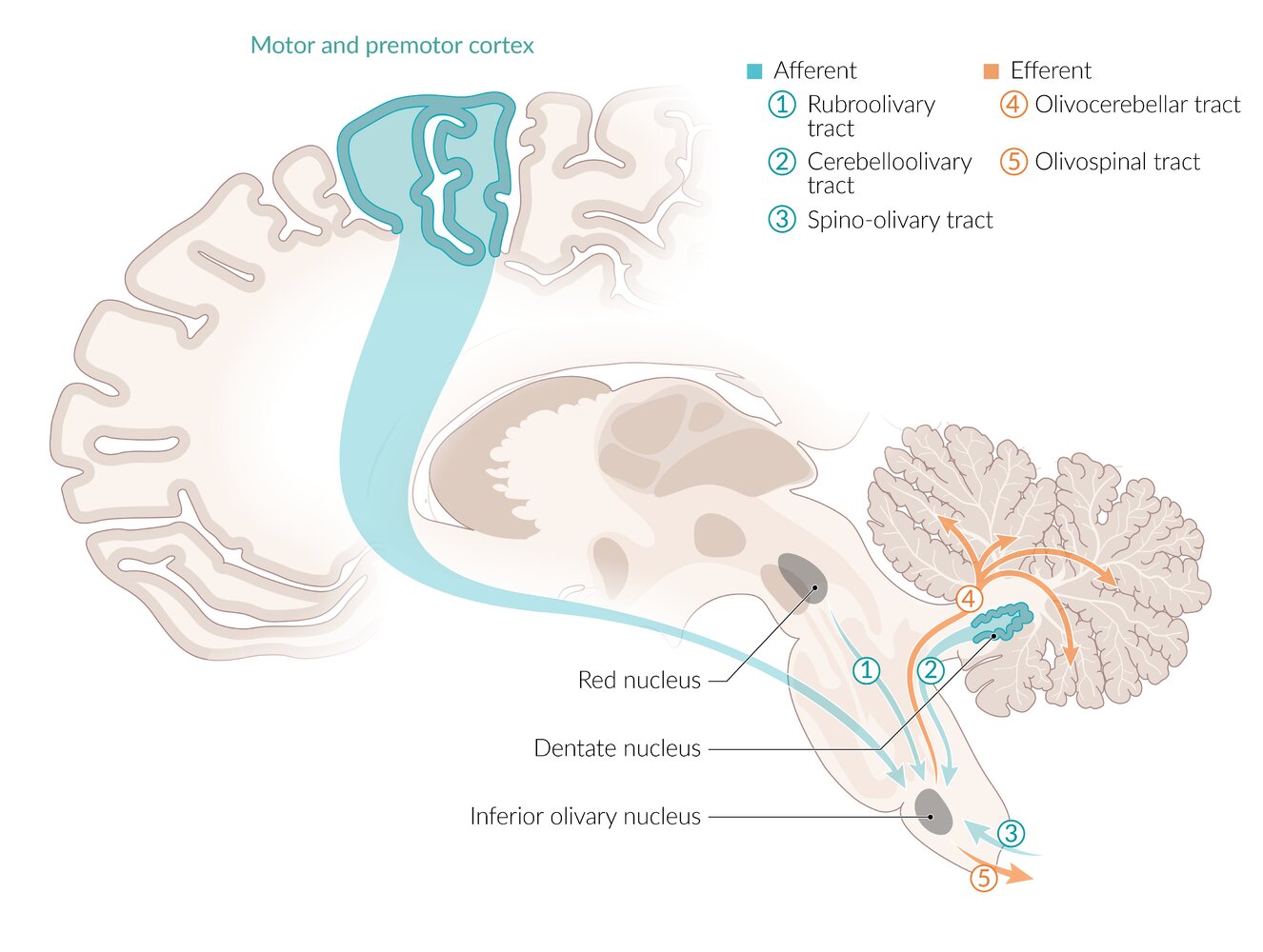
- Origin of the rubrospinal tract and rubroolivary tracts
|
|
Crura cerebri
|
- Form the base of the midbrain
|
- Corticospinal tracts
- Corticopontine tracts
- Corticobulbar tracts
|
- Voluntary movement of the contralateral side of the body
- Coordination of planned movement
- Voluntary movement of muscles of the face and neck
- For more information on spinal cord tracts, see “Spinal cord tracts and reflexes.”
|
|
Cerebellar peduncles
|
- Arise at the lateral ventral aspect of the pons
|
- Superior cerebellar peduncles
- Middle cerebellar peduncles
- Inferior cerebellar peduncles
|
- Relay motor planning signals from the cerebellum
- Relay proprioceptive signals to the cerebellum
- Connection of
-
Pons to cerebellum
-
Cerebellum to midbrain
-
Cerebellum to medulla and spinal cord
- For more information on the cerebellar peduncles, see “Cerebellar peduncles” in “Cerebellum.”
|
| Pretectal area (pretectum) |
- Dorsal side of the midbrain in close proximity to the tectum
- Between thalamus and superior colliculus
|
- Seven nuclei (e.g., olivary pretectal nucleus, optic tract nucleus)
|
- Part of the subcortical visual system
-
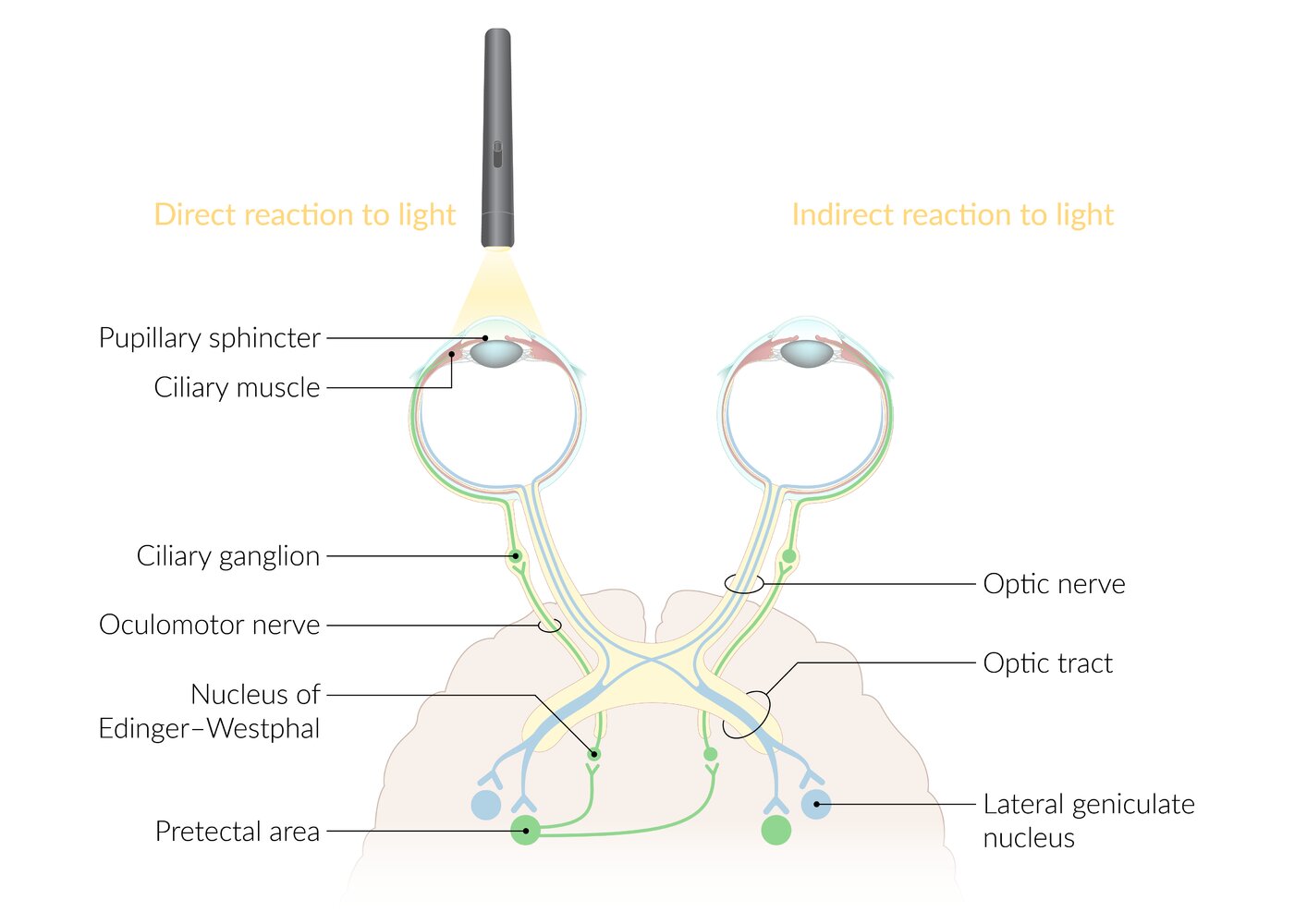
Modulates behavior in reaction to light (e.g., pupillary reflex and accommodation)
- Receives input from the retina and occipital cortical fields
- Projects to the Edinger-Westphal nucleus and the superior colliculus
|
|
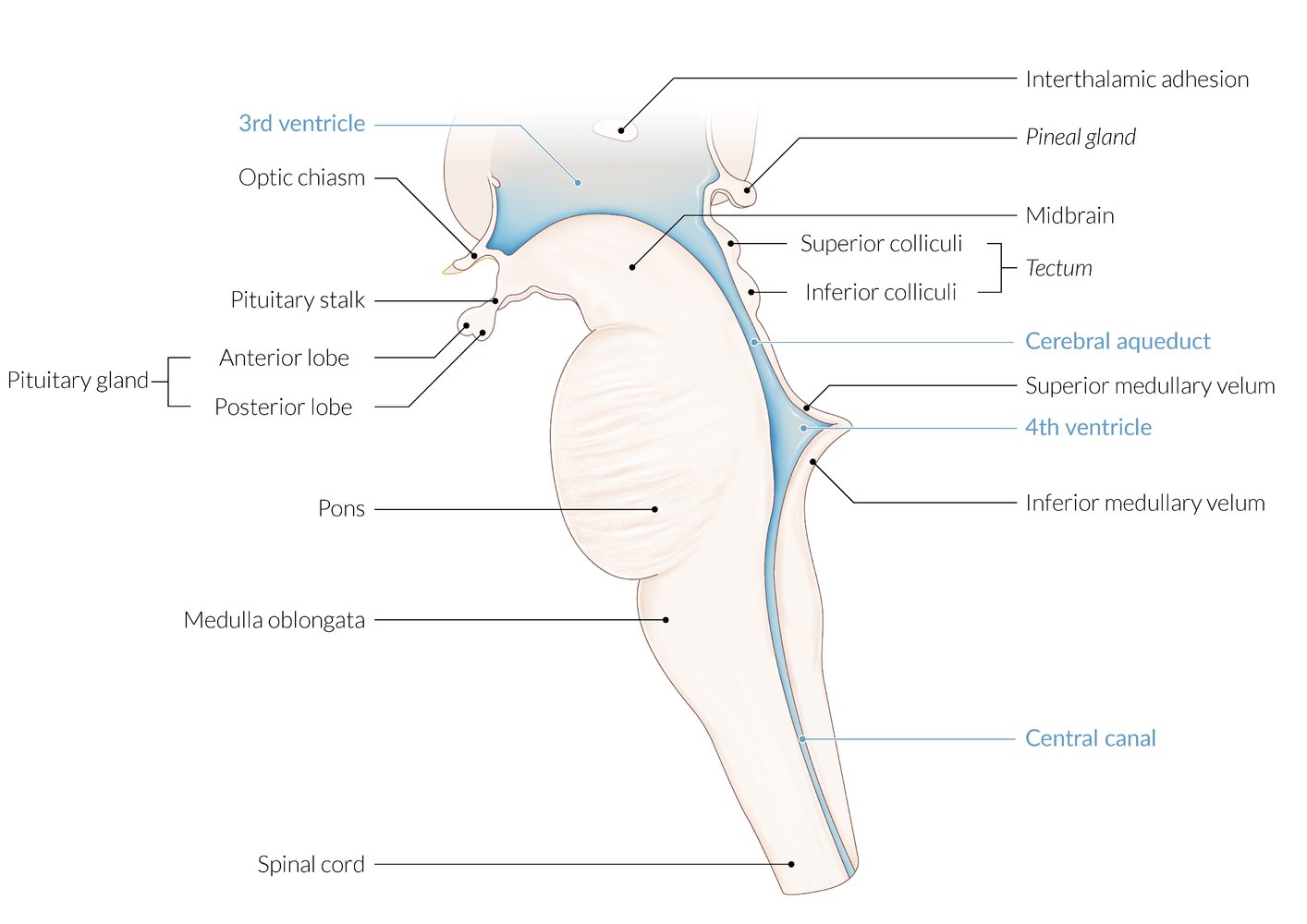
Cerebral aqueduct
|
- Between the tegmentum and the tectum
- Surrounded by periaqueductal gray matter
|
|
- Connects the 3rd and 4th ventricles
- Stenosis of this structure causes non-communicating hydrocephalus
|
|
Periaqueductal gray matter
|
- Surrounds the cerebral aqueduct
|
- Dorsal tegmental nucleus
- Dorsal raphe nucleus
|
- Part of the antinociceptive system
- Learning of defensive/aversive behavior
- Response to perceived threat (e.g., increased alertness, initiation of escape actions)
|
| Medial longitudinal fasciculus |
- Found on each side near the midline ventral to the fourth ventricle (in the medulla and pons) and cerebral aqueduct (in the midbrain)
|
-
White matter fiber bundles (ascending and descending)
|
- Coordinate eye movement
- Highly myelinated (to enable fast coordinated eye movements)
- Connect CN III, CN IV, and CN VI
- Lesions lead to internuclear ophthalmoplegia
- Common site of involvement in multiple sclerosis (esp. bilateral lesions)
|
| Central tegmental tract |
- From the midbrain to the inferior olivary nucleus in the medulla
|
- Ascending reticulothalamic fibers
- Descending rubroolivary fibers
- Taste fibers ascending from solitary nucleus to the VPM nucleus of thalamus
|
- Coordination of movement
- Relay of taste fibers
|
The inferior colliculi are the part of auditory pathway while the superior colliculi are the part of the visual pathway: ears are below the eyes.
Blood supply of the midbrain
-
Tectum: posterior cerebral artery
-
Tegmentum
- Posterolateral part: superior cerebellar artery
- Posteromedial part: penetrating interpeduncular branches of the basilar artery
-
Anterior part: penetrating peduncular branches of the posterior cerebral artery
-
Crura cerebri
-
Lateral parts posterior cerebral artery
- Middle parts penetrating peduncular branches of the posterior cerebral artery
-
Medial parts posterior choroidal artery (arising from the P2 segment of the posterior cerebral artery)
For information on the clinical relevance of the blood supply, see “Midbrain syndromes” in “Overview of stroke.”
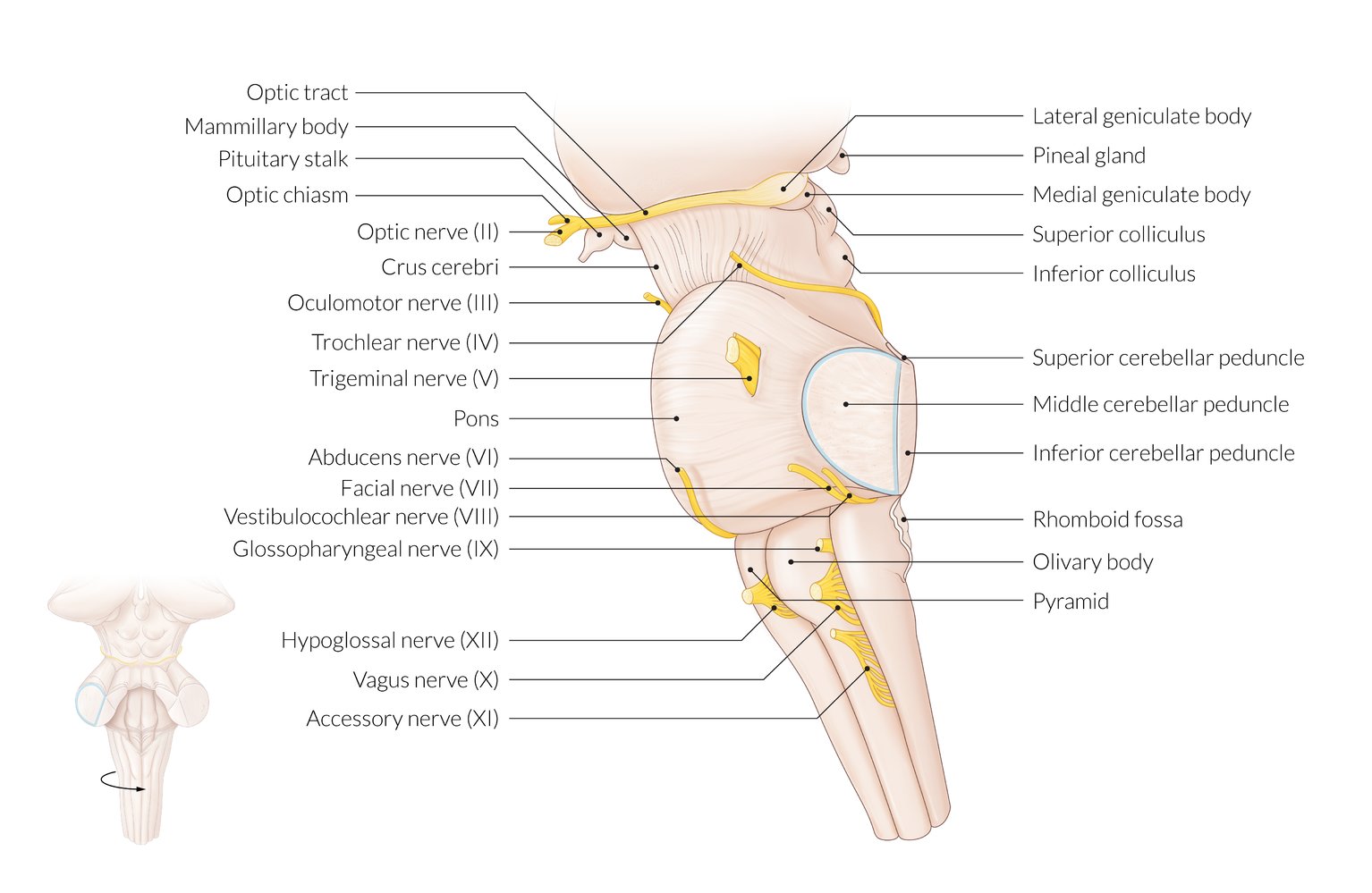

Characteristics
-
Location
-
Rostral to the medulla, caudal to the midbrain
- Connected to the cerebellum via the middle cerebellar peduncles
-
Function
- Conduction of nerve fibers and tracts (e.g., transmission of pain, temperature, proprioception, and auditory signals)
- Regulation of autonomic functions
-
Composition: divided into 2 parts (dorsal to ventral)
-
Pontine tegmentum: contains CN nuclei
- Trigeminal (CN V)
- Abducens (CN VI)
- Facialis (CN VII)
- Vestibulocochlear (CN VIII)
- For information on the cranial nerves, see “Cranial nerve types and functions” in “Cranial nerve palsies.”
- Basilar pons: contains relay nuclei (e.g., pontine nuclei) and nerve tracts
-
Embryogenesis: rhombencephalon → metencephalon → pons and cerebellum
Components of the pons
| Overview of the pons |
|---|
| Structure |
Location
|
Components |
Function |
| Cochlear nuclei |
- Dorsolateral aspect of the pons
|
- Ventral cochlear nuclei
- Dorsal cochlear nuclei
|
-
Part of the auditory pathway (second-order neuron)
-
Receive auditory signals from the cochlear branch of the vestibulocochlear nerve (CN VIII) via special somatic afferent fibers
-
Fibers project to the ipsilateral and contralateral lateral lemniscus via acoustic striae
|
| Trapezoid body |
- Ventral aspect of the pons, posterior to the pyramidal tracts
- Formed by a decussation of the ventral cochlear fibers
|
- Medial lemniscus (see below)
- Fibers of CN VI
-
Acoustic striae: axons originating from the cochlear nuclei
|
- Part of the auditory pathway
- Sound localization
|
| Superior olivary nuclei |
- At the level of the trapezoid body
|
|
-
Part of the auditory pathway (third-order neuron)
- First major point of integration of auditory information from both ears
- Relay auditory signals from the cochlear nuclei
- Join the lateral lemniscus (see below) and synapse on the neurons of the inferior colliculus (fourth-order neurons).
|
| Corticopontine tract |
|
- Frontopontine fibers
- Parietopontine fibers
- Temporopontine fibers
- Occipitopontine fibers
|
- Part of the corticopontocerebellar pathway
- Synapses in the pontine nuclei
|
| Pontine nuclei |
|
- Projection neurons
-
GABAergic interneurons
|
- Part of the corticopontocerebellar pathway
- Modulation of movement
- Relay cerebellar signals
|
| Locus coeruleus |
- Posterior portion of the rostral pons
|
- Melanin-containing nuclei
|
- Part of the reticular activating system
- Site of norepinephrine production
- Projects axons to numerous parts of the brain
|
| Medial lemniscus |
- Medial aspect of the midbrain, pons, and cranial medulla
|
- Formed by the decussation of internal arcuate fibers: myelinated axons that arise from the gracile and cuneate nucleus
|
- Pathway for proprioception
- Transmits vibration and fine touch
- Projects to: ventral posterolateral nucleus of the thalamus
|
| Lateral lemniscus |
- From trapezoid body to nucleus of inferior colliculus
|
-
Axons from the cochlear nuclei and superior olive
|
- Part of the auditory pathway
- Projects to the inferior colliculus
|
| Spinal lemniscus |
- Dorsolateral aspect of basilar pons
|
- Ascending afferent nerve fibers
|
- Part of the spinothalamic tract
- Nociception and heat sensation
|
Blood supply of the pons
- The main part of the pons is supplied by pontine arteries (penetrating branches of the basilar artery).
- The smaller, upper portion of the pons receives its blood supply from the superior cerebellar artery and the anterior inferior cerebellar artery.
- For information on the clinical relevance, see “Pontine syndromes” in “Overview of stroke.”
Pontine stroke can cause ipsilateral loss of function of the facial and abducens nerves with contralateral hemiparesis (Millard-Gubler syndrome or Foville syndrome).

Characteristics
-
Location
-
Rostral to the spinal cord, caudal to the pons
- Connected to the cerebellum via the inferior cerebellar peduncles
-
Function
- Regulation of autonomic functions (e.g., circulation, respiration, gastrointestinal activity)
- Contains centers for swallowing, sneezing, coughing, and vomiting
- Conduction of motor and sensory information
-
Composition
-
CN nuclei
- Part of the sensory trigeminal nerve nucleus (CN V)
- Glossopharyngeal (CN IX)
- Vagus (CN X)
- Accessorius (CN XI)
- Hypoglossal (CN XII)
- For information on the cranial nerves, see “Cranial nerve types and functions” in “Cranial nerve palsies.”
-
Fissures
-
Anterior median fissure: extends along the entire length of the medulla
-
Ventrolateral sulcus (preolivary sulcus)
- Separates the olives from the pyramids
- Contains rootlets of CN XII
- Posterolateral sulcus: contain rootlets of CN IX–XI
- Pyramids
- Area postrema
- A number of brainstem nuclei (e.g., nucleus gracilis, nucleus cuneatus, inferior olivary nucleus)
-
Embryogenesis: myelencephalon → medulla oblongata
Components of the medulla oblongata
| Overview of the medulla oblongata |
|---|
|
Structure
|
Location |
Fiber tracts and course |
Function |
| Gracile nucleus and cuneate nucleus |
- At the junction between the spinal cord and the medulla oblongata in the dorsal column
|
- Contain second-order neurons of the dorsal column-medial lemniscus pathway
- Axons from these neurons form the internal arcuate fibers in the pons
|
-
Both nucleirelay proprioception and fine touch from first-order neurons located in the dorsal root ganglia
- Gracile nucleus: lower trunk and legs
- Cuneate nucleus: upper trunk and arms
|
| Pyramids (brainstem) |
- Form the base of the medulla
- Pyramidal decussation: crossing of the fibers of the corticospinal tract from one side to the contralateral one, which occurs at the most caudal part of the medulla
|
- Contain the motor fibers of the corticospinal and corticobulbar tracts
|
|
| Accessory cuneate nucleus |
-
Lateral to the cuneate nucleus
|
- Contains second-order neurons of the cuneocerebellar tract
- Fibers travel to the cerebellum via the inferior cerebellar peduncle
|
-
Proprioception (upper extremities)
|
| Inferior olivary nucleus |
- Forms a swelling on the anterior surface of the medulla oblongata, lateral to both pyramids, called olivary bodies (or olives)
|
- Receives input from various sources including the red nucleus, cerebral cortex, and spinal cord
- Axons travel to cerebellum via ascending fibers in the contralateral inferior cerebellar peduncle
|
- Relays motor and sensory information to facilitate motor coordination
|
| Lateral reticular nucleus |
- Located at the caudal, ventrolateral medulla oblongata
|
- Receives input from the spinal cord, the cerebral cortex, the red nucleus, and superior colliculus
- Fibers travel to the cerebellum via the inferior cerebellar peduncle
|
- Relay nucleus for cerebellar signals
- Integration motor information
- Adjustment and regulation of motor activity
|
| Arcuate nucleus (medulla) |
|
- Receives input from the corticospinal tract
- Forms the arcuatocerebellar tract of the striae medullares (in the rhomboid fossa)
- Fibers travel to the cerebellum via the inferior cerebellar peduncle
|
- Chemoreception
- Breathing control (e.g., modulation of respiratory rate)
|
| Solitary nucleus |
- Located within the dorsomedial medulla
|
-
The solitary tract contains axons of the cranial nerves that provide input to the solitary nucleus:
- General visceral afferent signals from the glossopharyngeal (CN IX) and vagus nerves (CN X)
- Special visceral afferent signals from the facial (CN VII), glossopharyngeal (CN IX), and vagus nerves (CN X)
- Projects ipsilateral fibers to the posteromedial nucleus of the thalamus and the pons via the central tegmental tract
- Connected to the area postrema
|
- Relay nucleus for general visceral and taste afferents
- Blood pressure homeostasis (mediates the baroreceptor reflex)
|
|
Area postrema (vomiting center)
|
- Located anterior to the 4th ventricle on the floor of the medulla
|
-
Receives input from the:
- Nucleus tractus solitarius (main coordinator)
- GI tract via vagus nerve
- Vestibular system
- CNS
|
- Chemoreception
- Control of autonomic functions (e.g., blood pressure, appetite)
-
Triggers vomiting
- Contains the chemoreceptor trigger zone, a region with no blood-brain barrier and, accordingly, in direct contact with the bloodstream that can trigger vomiting when stimulated by certain circulating substances (e.g., toxins, hormones)
-
Receptors
- Muscarinic (M1)
- Histamine (H1)
- Neurokinin (NK–1)
- Dopamine (D2)
- Serotonin (5–HT3)
-
Antagonism of these receptors is used to treat:
- Chemotherapy-induced vomiting (NK–1, D2, and 5–HT3)
- Motion sickness (M1 and H1)
- Hyperemesis gravidarum (H1)
|
The gracilis muscle is a muscle of the lower body, the gracile nucleus relays fine touch and proprioception from the lower body.
Cross-sectional layers of the medulla oblongata
| Overview of cross-sectional layers in the medulla oblongata |
|---|
|
Level (from inferior to superior) |
Anterior (from medial to lateral) |
Posterior (from medial to lateral) |
Lateral (from posterior to anterior) |
Central (from posterior to anterior) |
| Decussation of pyramids |
- Anterior median fissure
- Pyramids
|
- Posterior median fissure
- Gracile fasciculus (posterior) and nucleus (anterior)
- Cuneate fasciculus (posterior) and nucleus (anterior)
|
- Spinal nucleus of the trigeminal nerve (CN V)
- Posterior spinocerebellar tract
- Lateral and anterior spinothalamic tracts (spinal lemniscus)
|
- Central canal
- Decussation of pyramids
- Medial longitudinal fasciculus (lateral to the decussation of pyramids)
|
| Decussation of medial lemnisci |
- Central canal
- Hypoglossal nucleus (CN XII)
- Medial longitudinal fasciculus (medial to the decussation of medial lemnisci)
- Internal arcuate fibers (decussation of medial lemnisci)
- Inferior olivary nucleus (lateral to the decussation of medial lemnisci)
|
|
Olives
|
- Pyramidal tracts
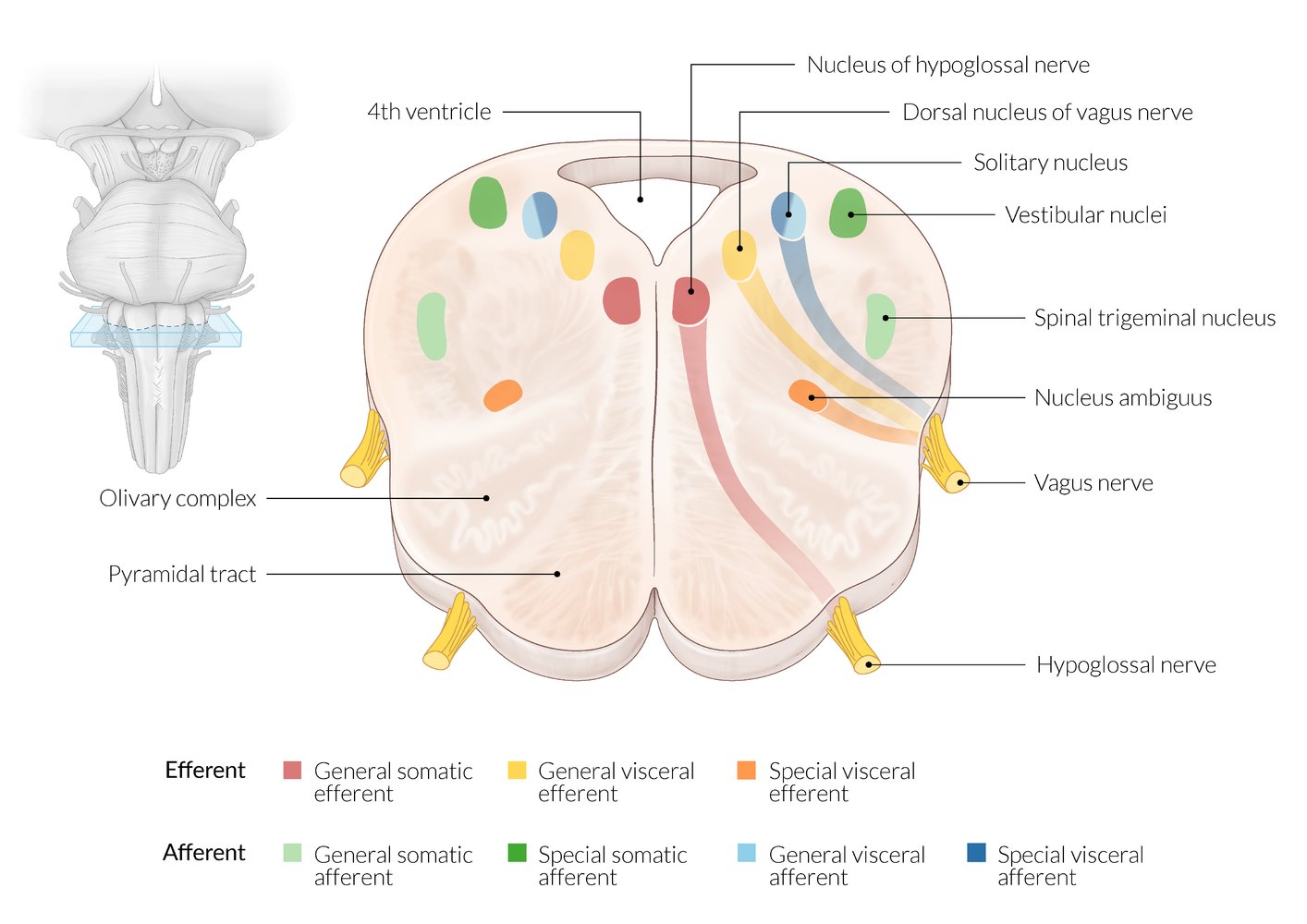
- Hypoglossal nerve (CN XII) rootlet
- Olivary complex
|
- 4th ventricle
-
Nuclei
- Hypoglossal nerve (CN XII)
- Dorsal nucleus of vagus nerve (CN X)
- Solitary nucleus
- Medial and inferior vestibular nuclei (CN VIII)
- Posterior cochlear nucleus (CN VIII)
|
- Inferior cerebellar peduncle
- Anterior cochlear nucleus (CN VIII)
-
CN rootlets:
- Vagus nerve (CN X)
- Glossopharyngeal nerve (CN IX, superior to CN X)
- Spinal nucleus of the trigeminal nerve
- Nucleus ambiguus
- Anterior and lateral spinocerebellar tracts
|
-
From posterior to anterior
- Medial longitudinal fasciculus
- Tectospinal tract
- Medial lemniscus
|
Blood supply of the medulla oblongata
-
Anteromedial part: anterior spinal artery
-
Posterolateral part
-
Posterior inferior cerebellar artery (branch of the vertebral artery) at the level of the olives (rostral part of the medulla)
-
Posterior spinal artery at the level of pyramidal decussation (caudal part of the medulla)
-
Lateral part: penetrating branches of the vertebral arteries
-
Clinical significance: medullary syndromes, bulbar palsy