The combination of an ongoing global increase in airline passengers and an aging population with more comorbidities means increasing numbers of patients with preexisting medical conditions are traveling by air. [1] Basic knowledge of how to assess fitness to fly on commercial airlines and how to respond to inflight medical events is therefore of increasing relevance to clinicians.
Space medicine is the practice of medicine on astronauts during spaceflight and involves the prevention and treatment of common illnesses in space. Stressors unique to space include effects of microgravity, spatial confinement, and limitations of remote help. There is a strong emphasis on prevention and preflight screenings because of limited medical equipment, diagnostic capabilities, and medications during spaceflight.
- Clinicians may be asked by the airline to provide a “Medical Certificate” regarding their patient's fitness to fly.
- The International Air Transport Association (IATA) recommends that such certificates be regarded as advisory only, with the airlines' own medical representatives ultimately being responsible for deciding whether a passenger is permitted to fly. This is because clinicians who are not specialized in aviation medicine are unlikely to be fully familiar with either the particular medical concerns of air travel or the medical capacities onboard, and medical clearance procedures differ significantly between airlines and internationally. [2]
- While this section outlines key areas to consider when assessing fitness to fly, concerns should always be discussed with the airline's designated medical representatives.
General considerations
- Preexisting medical conditions: potential inflight deterioration; limited inflight emergency medical resources (see “Inflight medical events”)
- Medications: dosage, timing, potential disruptive effects of travel
- Patients should be advised to carry medications and basic medical records (e.g., medication schedules) in their hand luggage.
- Need for assistance or special services such as wheelchairs, stretchers, lifting services, special meals, special seating, early boarding, and supplemental oxygen
-
Public health concerns (e.g., communicable diseases, vaccination status)
Relevant systems and conditions
|
System-based approach to preflight screening [1][2][3][4]
|
|---|
| System |
Key conditions/events |
Pathophysiology |
Investigations and patient advice |
| Respiratory |
|
- At a relative cabin altitude of 8,000 feet, the decreased barometric pressure results in a PaO2 of 60–70 mm Hg and an SaO2 of ∼ 90%, even in healthy travelers.
- Individuals with a low baseline PaO2 can develop hypoxemia.
|
- Contraindications to air travel:
- Untreated pneumothorax or within 2 weeks of drainage and full expansion
- Active or contagious respiratory infections
- Labile asthma or recent hospitalization with asthma
- Perform an ABG for patients with symptomatic pulmonary conditions:
-
PaO2 > 70 mm Hg at sea level should allow the patient to fly without O2 supplementation.
- Patients with stable conditions who do require supplemental O2 usually cannot bring their own, but most airlines will supply O2 at 2–4 L/min for a fee. [1]
-
Obstructive lung disease: advise patients to carry their inhalers and an emergency course of oral steroids in hand baggage
|
| Cardiovascular |
- Coronary artery disease
-
Congestive heart failure (CHF)
|
- The hypoxemic stress due to decreased barometric pressure can aggravate underlying heart disease.
|
- Contraindications to air travel:
- Unstable angina
- Severe or decompensated CHF
- Uncomplicated myocardial infarction within 3 weeks of flying
- Complicated myocardial infarction within 6 weeks of flying
-
Coronary artery bypass surgery within 2 weeks of flying
-
CHF: supplemental O2 advised for patients with NYHA class III-IV or baseline PaO2< 70 mm Hg
- Established pacemakers and implanted cardiac devices are unaffected by airport security devices and are not a contraindication to flying, but whenever possible, travelers with these devices should carry ECG recordings with the pacemaker switched on and off.
- In addition to their medications, travelers should carry a recent ECG in hand baggage.
|
| Communicable diseases |
- Respiratory infections requiring airborne precautions and/or droplet precautions
|
- Available data is limited, but risk of transmission appears highly variable and is affected by cabin air recirculation and filters. [5]
|
- Contraindications to air travel:
- Any active or contagious infection that could be transmitted to other passengers (advise against travel until the end of the infectious period)
- For tuberculosis, a minimum of 2 weeks of treatment with a documented response is required before air travel can be permitted. [2]
|
| Hematological |
-
Deep vein thrombosis (DVT)
- Anemia
- Sickle cell disease
|
- Increased risk of thrombosis for travel > 4 hours [1]
- Patients with anemia are more vulnerable to the hypoxemic stress of air travel.
|
- Individuals at low risk for DVT (see “Risk factors for DVT”): Advise nonpharmacological measures such as moving about the cabin and isometric calf exercises.
- Individuals at moderate or high risk for DVT: Consider compression stockings and low molecular weight heparin (see “Prevention” in “deep vein thrombosis”).
-
Anemia: Consider the need for supplemental O2 in anemia with Hb < 8.5 g/dL. [3]
-
Sickle cell disease: Patients should travel with supplemental oxygen (not necessary for sickle cell trait) and defer travel for ∼ 10 days after a sickling crisis. [4]
|
| Neurological |
|
- Fatigue, disturbed circadian rhythm, and hypoxia can lower the seizure threshold.
|
- Patients with a seizure disorder should carry their anticonvulsant drugs in hand luggage for easy access.
- Advise patients with frequent seizures to consider traveling with a companion.
- Travel after a cerebrovascular accident or transient ischemic attack should be delayed until the patient's condition is stable.
[3]
|
| Endocrine |
-
Diabetes mellitus requiring insulin therapy
|
- Time zone changes and associated meal time changes necessitate medication adjustments.
-
Insulin pumps may increase delivery slightly on the ascent as ambient pressure drops. [4]
|
- Advise patients to carry twice the amount of all necessary medications and equipment; at least half of these supplies should be carried in hand luggage.
- A physician's letter that contains information regarding the diagnosis, drug dosages, and if applicable the need to travel with needles and syringes is advisable.
- There are algorithms for insulin adjustment in eastward and westward travel, but self-monitoring of blood glucose using a glucometer may be more simple for the patient.
|
| Psychiatric |
|
- Air travel may be contraindicated if the patient's behavior is unpredictable or disruptive.
|
- Close liaison between treating physician and airline
- Consider traveling with a patient escort or companion.
|
| Surgical |
- Recent open abdominal surgery
- Recent surgeries involving significant blood loss
-
Pneumonectomy or lobectomy with decreased pulmonary reserve
- Neurosurgical patients
- Orthopedic patients with plaster casts
|
- Postoperative patients have increased O2 consumption and may be more vulnerable to the hypoxemic stress of air travel.
- Postoperative anemia has increased as transfusion has become less routine ; cases of severe anemia may necessitate supplemental oxygen.
- Intestinal gas from a postoperative relative ileus expands at altitude and can cause bleeding or even perforation.
- Trapped intracranial gas also expands at altitude and will increase intracranial pressure.
[3]
|
- At a minimum, advise against air travel within 1–2 weeks of abdominal surgery and within 1 week of neurosurgery.
- Consider the need for supplemental O2 in postoperative anemia with Hb < 8.5 g/dL. [3]
- Most airlines prohibit flying within 24–48 hours of plaster cast application because of the increased risk of tissue swelling and compartment syndrome in this period. [2]
|
| Otolaryngological |
- Acute or chronic rhinosinusitis
- Allergic rhinosinusitis
- Active middle ear infection or effusion
- Recent surgery affecting the inner or middle ear
- Dental disease
- Motion sickness
|
- Gas trapped in the middle ear or paranasal sinuses as a result of eustachian tube dysfunction can expand at altitude and cause pain (barotitis media) or even tympanic membrane rupture (barotrauma). [3]
- Gas trapped in the paranasal sinuses as a result of occlusion of the sinus ostia can expand at altitude and cause sinus headache (barosinusitis).
|
- Contraindications to air travel:
- Recent otolaryngological procedures involving the inner or middle ear
- Active middle ear infection or effusions without a tympanostomy tube in place
- Patients with rhinitis or sinusitis should be advised on measures to prevent occlusion of the sinus ostia and eustachian tube.
- Use of topical or systemic decongestants
- For older children and adults, frequent swallowing and the use of chewing gum during ascent and descent
- For infants. bottle feeding and the use of a pacifier during ascent and descent
- Patients with motion sickness can be prescribed oral first-generation antihistamines (e.g., diphenhydramine) or transdermal scopolamine.
|
| Ophthalmological |
-
Retinal detachment surgery
|
-
Retinal detachment surgery may involve intraocular gas injections. Remnant gas expands at altitude and can cause visual loss.
|
- Contraindications to air travel:
- Intraocular injection of perfluoropropane within 6 weeks
- Intraocular injection of sulfur hexafluoride within 2 weeks
- Other intraocular procedures or penetrating eye injuries within 1 week
- Contact lens wearers, or patients with dry eye conditions such as keratoconjunctivitis sicca, may find the dry cabin atmosphere unpleasant. Advise the use of lubricating eye drops.
|
| Pregnancy |
- Multiple or complicated pregnancies
- Single pregnancies in the third trimester
|
- Cabin environments are not known to be hazardous to pregnancy.
- Inflight delivery is a concern.
|
- Most airlines will: [4]
- Request a medical certificate confirming an uncomplicated pregnancy and an expected date of delivery after ∼ 28 weeks
- Refuse travel for multiple pregnancies after ∼ 32 weeks
- Refuse travel for single pregnancies after ∼ 36 weeks
|
| Miscellaneous |
|
- The risk of decompression sickness after scuba diving is increased by the low barometric pressures of flying.
|
- Recommended intervals prior to flying: [3]
- After a single dive: 12 hours
- After multiple dives or dives with decompression stops: 24 hours
- After treatment for decompression illness: 72 hours
|
Although inflight medical events (IFMEs) are relatively rare, there is a realistic chance that clinicians will have to provide onboard medical assistance within their lifetime. IFMEs pose a special challenge because of limited patient information and medical equipment, confined space, language barriers, and legal uncertainties.
Epidemiology [6][7]
-
Incidence of IFME [6]
- 1 per 604 flights
-
24–130 per 1 million passengers.
-
Aircraft diversion (i.e., landing of the aircraft at a destination other than the scheduled one because of a medical emergency) occurs in ∼ 4.4% of IFMEs. [6]
- Mortality from IFME: only 0.3% of IFMEs result in death [7]
Etiology [6][8]
Risk factors in the cabin environment for an IFME
- Low cabin pressure: Reduced air pressure leads to an expansion of gases in closed gas or air containing compartments of the body (e.g., sinuses, middle ear; nonphysiological spaces such as pneumothorax or postsurgical gas collections).
- Low partial pressure of oxygen: Mild hypoxia (blood oxygen saturation ∼ 90%) leads to compensatory hyperventilation and tachycardia.
-
Immobilization: hydrostatic edema of the lower limbs
- Low cabin air humidity: In combination with hyperventilation, this can precipitate dehydration or exacerbation of respiratory conditions.
Most common IFMEs [6]
-
Syncope or near syncope (30%): see “Differential diagnoses” in “Syncope”
-
Gastrointestinal symptoms (15%): see “Nausea and vomiting”, “Dyspepsia”, and “Diarrhea”
- Respiratory symptoms (10%): see “Dyspnea”, “Bronchospasm”, and “Asthma”
- Cardiovascular symptoms (7%): see “Acute coronary syndrome”, “Overview of cardiac arrhythmias”, “Chest pain” and “Dyspepsia”
-
Stroke or stroke-like symptoms (5%): see “Stroke”
-
Seizure (5%): see “Seizure disorders”
- Trauma (5%): see “Management of trauma patients”
- Psychiatric symptoms (3%): see “Panic disorder” and “Specific phobia”
-
Substance abuse or withdrawal (3%): see “Substance-related and addictive disorders”
-
Allergic reaction (2%): see “Anaphylaxis”
- Obstetric emergencies (1%): see “Childbirth” and “Antepartum hemorrhage”
-
Cardiac arrest (0.2%): see “Cardiopulmonary resuscitation”
General considerations for IFME management
Ground-based medical support [6]
- Many airlines work with ground-based physicians who are trained in aviation and emergency medicine. These physicians are contacted via radio or satellite telephone by the pilot and can provide guidance to medical volunteers or cabin crew in case of IFMEs.
Procedure [8]
After the flight crew requests medical assistance:
-
Assess your capability of helping the patient. Did you consume alcoholic beverages or take medications that might impair your judgment?
- Introduce yourself to the cabin crew and describe your medical qualifications.
- Some airlines require proof of medical license.
- Ask for a medical emergency kit.
- Introduce yourself to the patient in a calm manner.
- Obtain the patient’s consent if possible; crew members can serve as witnesses.
- Communication may be difficult due to language barriers. If a language interpreter is needed, consider patient privacy.
- Take patient history, perform a focused physical examination, and obtain vital signs.
- Remember a pulse oximeter reading of ∼ 90% is normal at standard cabin air pressure.
- If a loud cabin environment makes auscultation for manual BP measurement impossible, confirm systolic BP by palpating the radial artery during cuff deflation or watching for return of the pulse oximeter waveform.
- Administer treatments (in coordination with ground-based medical support if available and within your expertise).
- If the necessary medication is not included in the airplane emergency kit, ask the patient if they have their own medications. Consider asking other passengers if the patient does not have medications with them.
- Ensure proper positioning of the patient: seated if possible, but if there is impaired consciousness or the condition is potentially life-threatening, supine in a more spacious area such as the kitchen or lavatory area, to allow any necessary resuscitative measures
- Discuss your assessment with the pilot and ground-based medical support and recommend aircraft diversion if the patient is critically unwell.
- Provide care until the patient is stabilized or you are able to transfer care to other medical personnel.
-
Document your medical assistance (some airlines provide standardized forms).
A pulse oximeter reading of ∼ 90% is normal at standard cabin air pressure.
Auscultation will likely be more difficult due to the noise and vibration of the aircraft.
Aircraft diversion [6]
The pilot makes the ultimate decision to divert the aircraft. All other personnel involved, including ground-based physicians, flight staff, and medical volunteers onboard, act in a purely advisory capacity. Volunteer care providers are not usually knowledgeable about many of the factors involved in deciding aircraft diversion (e.g., medical capabilities of the nearest airports, operational risks of landing at particular sites).
Contents of medical emergency kits [6]
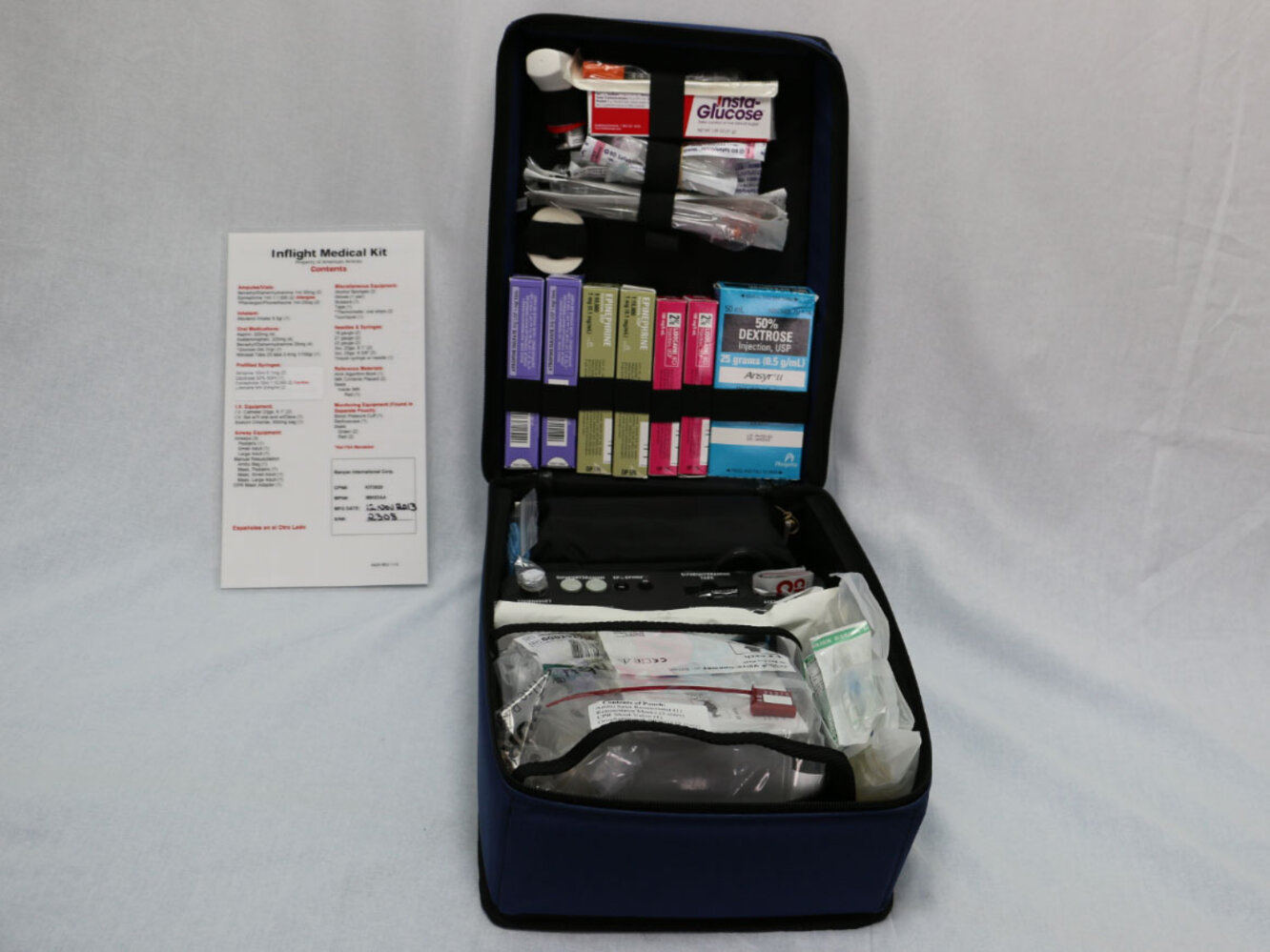
All US airlines must have an emergency kit on board that fulfills the minimum requirements of the Federal Aviation Administration (FAA). These emergency kits include:
- Equipment for basic medical assessment, hemorrhage control, and intravenous fluid and medication administration
- Medications to treat common medical conditions, including severe symptoms (e.g., mild pain, allergic reactions, bronchoconstriction, hypoglycemia, dehydration, certain cardiac conditions)
- An automated external defibrillator
- Some airlines provide a wider selection of devices and medications. Common supplementary devices and medications include a glucometer, urinary catheter, antiemetic and anticonvulsant medications, and an expanded selection of analgesic and cardiac medications.
- Oxygen bottles available on commercial aircraft usually provide an oxygen flow of 2 L/min (low) or 4 L/min (high). Oxygen supplies may not be sufficient for the full duration of the flight, even for a single passenger.
| FAA-mandated medical emergency kit |
|---|
| Equipment |
Medications |
- Oropharyngeal airways
- Adhesive tape, 1-in
-
Alcohol sponges
-
Cardiopulmonary resuscitation mask
- Intravenous administration set
- Needles
- Protective gloves
- Sphygmomanometer
- Stethoscope
- Syringes
- Tape scissors
-
Tourniquet (for IV catheter placement)
- Manual resuscitation device with 3 masks
- Instructions on kit use
|
-
Analgesic, nonnarcotic
-
Antihistamine, 50 mg, injectable
-
Antihistamine tablets, 25 mg
-
Aspirin tablets, 325 mg
-
Atropine, 0.5 mg, 5 mL
-
Bronchodilator, inhaled
- Dextrose, 50%/50 mL, injectable
-
Epinephrine, 1:1000, 1 mL, injectable
-
Epinephrine, 1:10 000, 2 mL, injectable
-
Lidocaine, 5 mL, 20 mg/mL, injectable
-
Nitroglycerin tablets
- Saline solution, 500 mL
|
Pulse oximetry equipment is not mandated by the FAA!
Legal considerations [6][8][9]
- In general, the country under which the airline operates has jurisdiction.
- In the US, Canada, England, and Singapore, physicians are not legally bound to provide medical assistance unless there is a preexisting physician-patient relationship. In contrast, Australia and many European, Middle Eastern, and Asian countries have laws that require physicians to help in case of medical emergencies.
- Legal liability:
- In the United States, clinicians providing medical assistance are protected from legal liability by the Aviation Medical Assistance Act (i.e., “Good Samaritan” law), except in cases of gross negligence or willful misconduct.
- Some international airlines provide “declarations of assumptions of legal liability” to protect medical volunteers from legal action.
- In practice, the risk of legal action after inflight medical assistance is minimal.
- Clinicians who provide medical assistance should not be under the influence of alcohol, illicit drugs, or sedating medications.
- Basic first aid and CPR/AED training for the cabin crew is required in the US.
In practice, the risk of legal action after inflight medical assistance is minimal.
|
Common complications of space travel [10] [11] |
|---|
| System |
Conditions |
Pathophysiology |
Manifestations |
Prevention |
| Musculoskeletal |
- Osteopenia
- Muscular atrophy
|
-
Bone remodeling, demineralization, and subsequent loss due to lower mechanical stress in microgravity
- Muscular atrophy due to unloading of skeletal muscle (e.g., to maintain posture) in microgravity
|
- Average bone loss of 1–2% per month
- Loss of muscle mass and strength, particularly in the lower extremities
|
- Regular resistance and cardiovascular training during spaceflight (e.g., treadmill, cycle ergometer, rower)
- Adequate nutrition (e.g., vitamin D supplementation)
|
| Cardiovascular |
- Hypotension
- Fluid redistribution
- Hypovolemia
- Arrythymia (e.g., PVCs, PACs)
- Post-spaceflight orthostatic intolerance
|
-
Hypotension: lower blood pressure and heart rate due to a physiological adaptation to reduced postural stress on the heart
- Fluid redistribution: redistribution of blood to the upper extremities due to microgravity for the first few days in spaceflight
-
Hypovolemia: reduction of plasma volume by 10–15%
-
Arrhythmia due to:
- Changes in the autonomic nervous system
- Cardiac remodeling
- Prolonged QT interval
- Post-spaceflight orthostatic intolerance: pooling in the lower extremities upon landing on Earth
|
-
Hypotension: mostly asymptomatic
- Fluid redistribution: facial edema (i.e., “puffy face”) for the first few days in spaceflight
-
Arrhythmia: fatigue, palpitations
- Orthostatic intolerance: light-headedness, syncope
|
- Post-spaceflight orthostatic intolerance
- Before landing on earth, wearing an anti-G suit, which has inflatable parts in the lower extremities to resist blood pooling
- A few days after return to earth, rehabilitation for cardiovascular adjustment
|
| Immune system |
- Dormant viral reactivation (e.g., herpes simplex virus)
- Increased risk of infection
|
- Evidence of immune dysregulation:
- Reduced cell-mediated immunity due to reduced number of T cells
- Altered cytokine levels
- Reduced antimicrobial functions of monocytes and neutrophils
- Evidence of increased virulence and antibiotic resistance of pathogens (e.g., Salmonella typhimurium, Escherichia coli)
|
-
Site-dependent symptoms of infection (e.g. cold sores, rash, fever in herpes simplex virus reactivation)
|
- Adequate nutrition during spaceflight
- Regular bacterial testing of shuttle consumables and environments (e.g., room air)
|
| Vestibular |
|
- Desynchronized stimuli to the brain coming from the vestibular, visual, and proprioceptive systems due to microgravity
|
-
Nausea, headache, vomiting
|
- Preflight adaptation training
- Limiting head movements in the first couple of days in spaceflight
- Use of transdermal dimenhydrinate patches during EVA (extravehicular activity) to prevent vomiting
-
Promethazine as indicated
|
| Visual |
-
Spaceflight-associated neuro-ocular syndrome
|
-
Microgravity-associated increased intracranial pressure
- Altered ophthalmic anatomy due to microgravity (e.g., papilledema, choroidal folds, globe flattening)
|
-
Headache, visual acuity deterioration
|
- Mitigation treatments, such as exposure to artificial gravity systems, are being developed.
- Preflight and postflight screenings for elevated intracranial pressure
|
| Neurologic |
-
Sleep disorders (especially circadian rhythm sleep disorders)
|
- Unusually short light-dark cycles (every 90 minutes) onboard the international space station (ISS) and heavy workload
- Factors affecting sleep hygiene: noise, mechanical discomfort, temperature changes
|
- Difficulty falling asleep
- Performance and concentration decline due to nonrestorative sleep
|
- Optimized sleep hygiene, including regular sleep schedule and exercise
- Daily dose of supplementary melatonin
|
| Psychiatric |
- Transient anxiety disorder
- Depression
- Postflight asthenization
|
- Increased number of stressors encountered in spaceflight:
- Physical: microgravity, acceleration, radiation
- Psychological: isolation, confinement, danger, monotony
- Interpersonal: cultural differences, personality conflicts
-
Asthenization: an adjustment reaction
|
- Fatigue, irritability, concentration decline, loss of appetite, psychosis
-
Asthenization: a syndrome experienced after long-term spaceflight involving fatigue, sleeping disorders, irritability, emotional lability, lack of appetite, difficulties with attention and concentration
|
- Treatment of an underlying sleep disorder if present
- Inflight and postflight psychotherapy
|
| Multisystem involvement |
|
- Large spikes in radiation due to solar flares can cause acute radiation injury
- Increased background radiation unique to outer space (e.g., high-energy protons, alpha particles, high-atomic-number ions)
|
- Acute radiation injury
- Long-term effects
- Increased risk of malignancy
-
Early-onset Alzheimer disease
- Degenerative tissue disorders (e.g., heart disease, cataracts)
- For more information, see “Chronic radiation injury”.
|
- Preflight predictions of solar activity
- Protective suits during EVAs
|