This chapter gives an overview of the important structures, muscles, fasciae, and vessels (arteries, veins, lymph, nerves) of the head and neck region. The brain, one of the most important organs, is protected by the skull, both of which are covered in other articles. There are also individual articles for the organs of perception as well as for the thyroid gland, the salivary glands, teeth and oral cavity. The head and neck region is the beginning of the respiratory and digestive tract, both of which also have their own articles.
Organs of the head
- Eye and orbit
- The ear
- Nose and sinuses
- Skull, the cerebral cortex, meninges, basal ganglia, and ventricular system, vertebral column, brainstem, cerebrovascular system
-
Oral cavity structures e.g.:
- Palate
- Tonsils
- Teeth
- Salivary glands
Organs of the neck
- Larynx
- Trachea
- Pharynx
- Esophagus
- Airways and lungs
- Thyroid gland and parathyroid glands
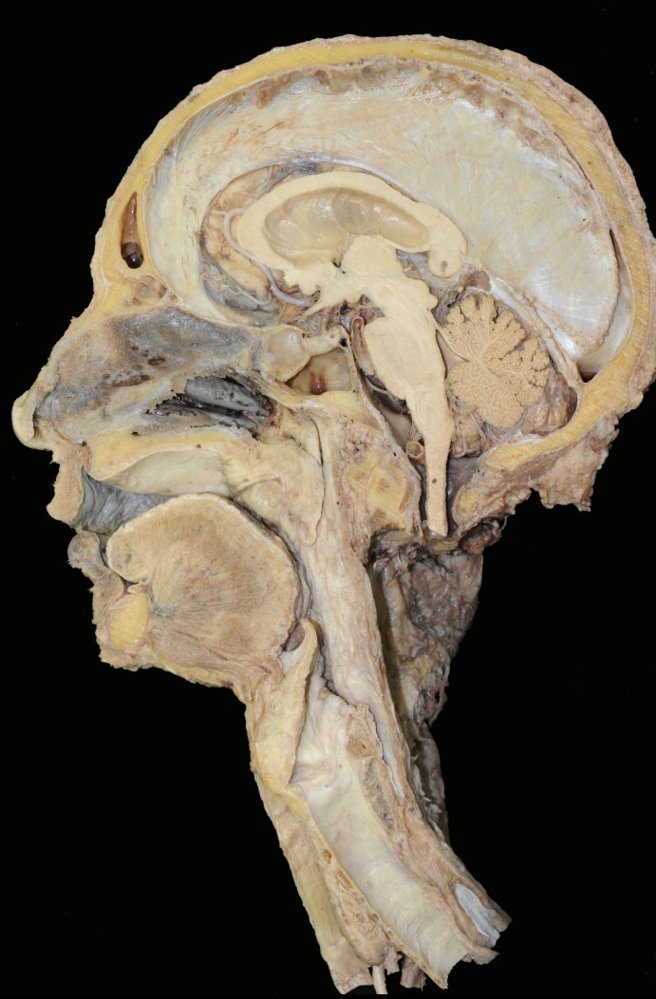
Regions of the head
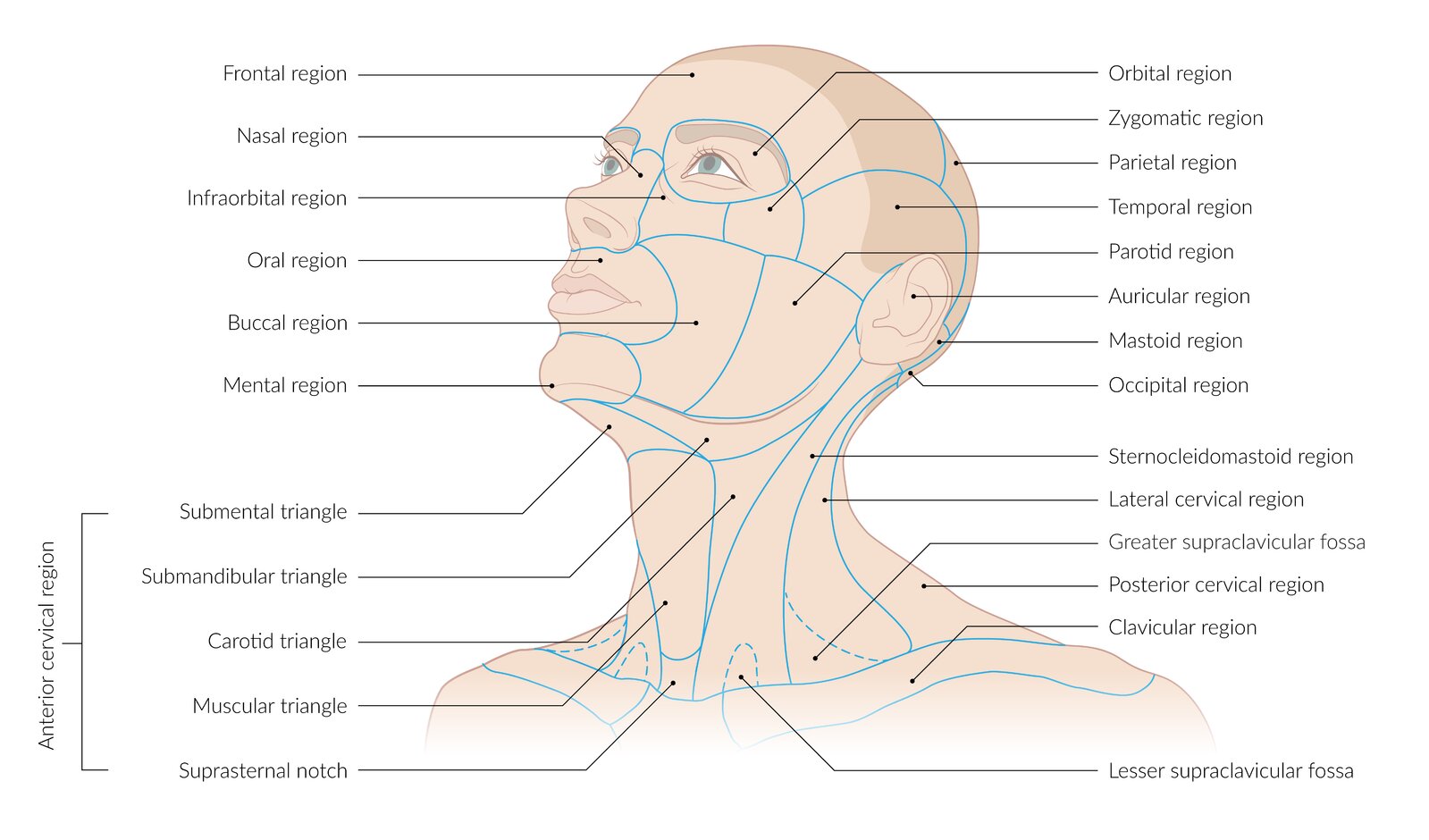
The head is divided into 14 regions:
- Frontal region
- Parietal region
- Occipital region
- Temporal region
- Auricular region
- Mastoid region
- Facial region
- Orbital region
- Infraorbital region
- Nasal region
- Zygomatic region
- Buccal region
- Parotid region
- Oral region
- Mental region
Regions of the neck
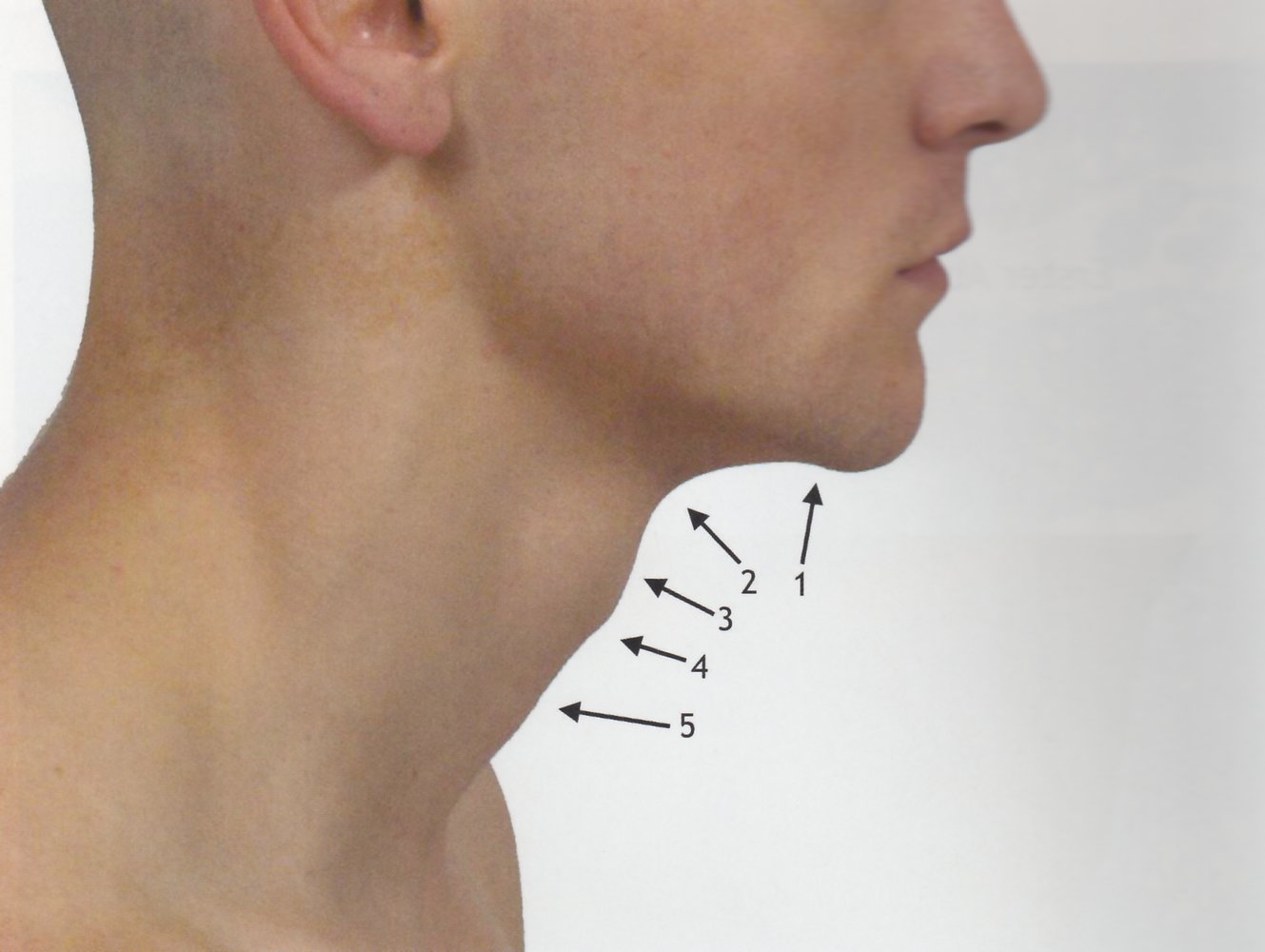
- The sternocleidomastoid muscle, trapezius, and clavicle are important landmarks for orientation on the neck.
- At the anterior midline, the laryngeal prominence forms the “Adam's Apple” due to the underlying thyroid cartilage.
- The hyoid bone can be palpated between the laryngeal prominence and the chin.
- The neck is divided into 4 regions
- Sternocleidomastoid region
- Posterior cervical region
- Lateral cervical region
- Anterior cervical region
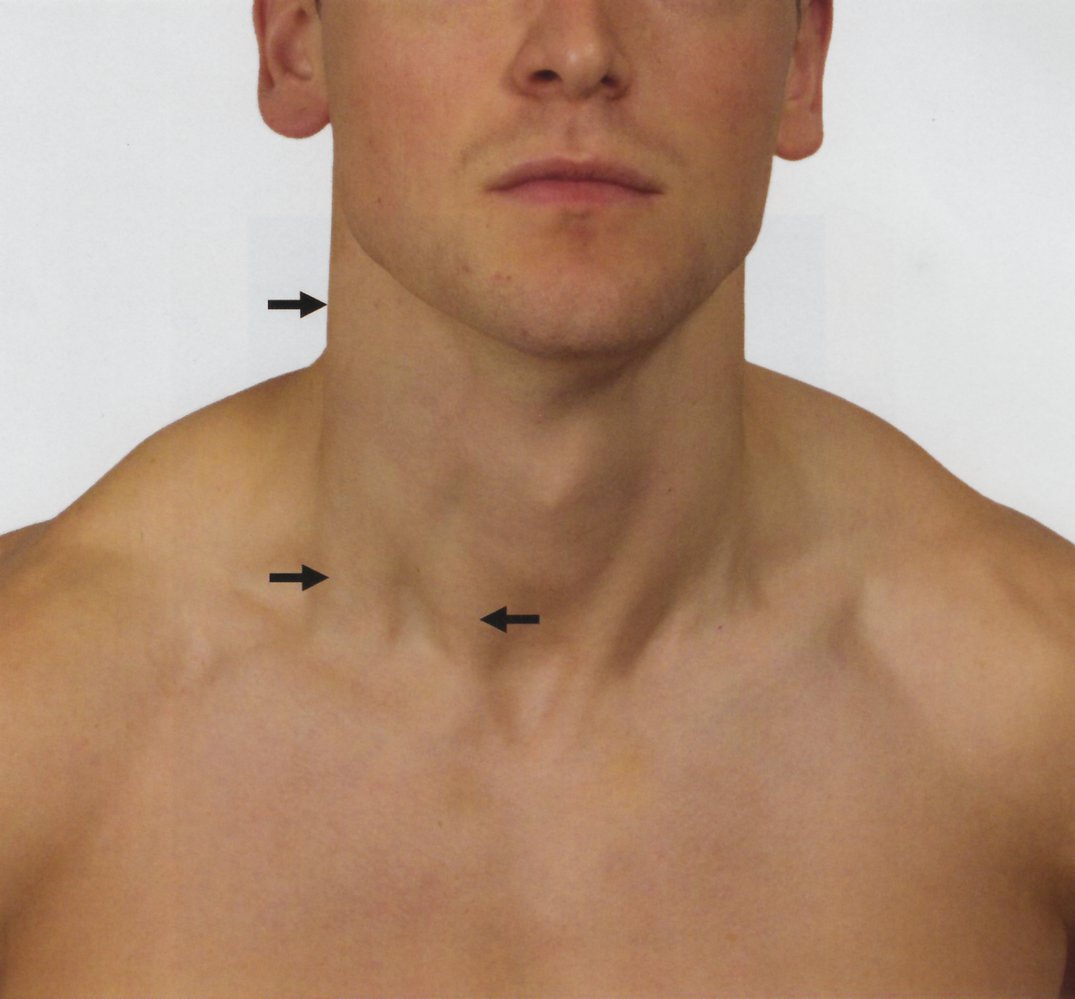
Anterior cervical triangle
-
Borders
- Anterior: midline in front of the neck
- Superior: mandible
- Inferolateral: sternocleidomastoid muscle
-
Triangles: subdivided into four smaller triangles by the digastric and omohyoid muscles
-
Submandibular triangle
- Bounded by mandible and the two bellies of the digastric muscle
- Contains submandibular salivary glands, hypoglossal nerve, and facial artery
-
Carotid triangle
- Bounded by the sternocleidomastoid muscle, posterior belly of digastric muscle, and superior belly of omohyoid muscle
- Contains carotid artery, internal jugular vein, and vagus nerve
-
Muscular triangle
- Bounded by the midline, hyoid bone, sternocleidomastoid muscle, and superior belly of the omohyoid muscle
- Contains thyroid and parathyroid glands
- Submental triangle: bounded by mandible, hyoid, and anterior belly of digastric muscle
-
Submandibular triangle

Posterior cervical triangle
-
Borders
- Posterior: trapezius muscle
- Inferior: clavicle
- Anterosuperior: sternocleidomastoid muscle
-
Triangles: subdivided into two smaller triangles by the omohyoid muscle
-
Occipital triangle
- Bounded by the sternocleidomastoid, trapezius, and omohyoid muscles
- Contains the brachial plexus, omohyoid muscles, and accessory nerve
-
Subclavian triangle
- Bounded by inferior belly of omohyoid muscle, clavicle, and the sternocleidomastoid muscle
- Contains the subclavian muscles, brachial plexus, and external jugular vein
-
Occipital triangle
Suboccipital triangle
- Position: paired region in the deep area of the neck that is covered by the trapezius muscle, splenius muscle, and semispinalis capitis
-
Borders
- Cranial: rectus capitis posterior major
- Caudal: obliquus capitis inferior
- Lateral: obliquus capitis superior
-
Anatomical structures within
- Vertebral artery
- Vertebral venous plexus
- Suboccipital nerve

References:[1]
Head muscles
Muscles of facial expression
- Move the skin of the face, the alar wings of the nose, the eyelids, and lips
- Enable us to express emotions
- Not connected to bones but only to the skin
- Do not have fasciae
- All innervated by the facial nerve
Muscles of the cranium
| Muscle | Function |
|---|---|
| Occipitofrontalis muscle |
|
| Temporoparietal muscle |
|
Muscles of the ear
| Muscle | Function |
|---|---|
| Anterior auricular muscle |
|
| Superior auricular muscle |
|
| Posterior auricular muscle |
|
Muscles of the eye
| Muscle | Function |
|---|---|
| Orbicularis oculi |
|
| Corrugator supercilii |
|
Muscles of the nose
| Muscle | Function |
|---|---|
| Nasalis |
|
| Depressor septi nasi |
|
| Procerus |
|
Muscles of the mouth
| Muscle | Function | |
|---|---|---|
| Orbicularis oris |
|
|
| Buccinator |
|
|
| Upper group | Levator labii superioris, levator labii superioris alaeque nasi muscle, risorius, levator anguli oris, zygomaticus major, zygomaticus minor |
|
| Lower group | Depressor anguli oris, depressor labii inferioris, mentalis |
|
For mastication muscles and muscles of the tongue, see “Oral cavity.”
The facial nerve (VII) innervates all muscles of facial expression.
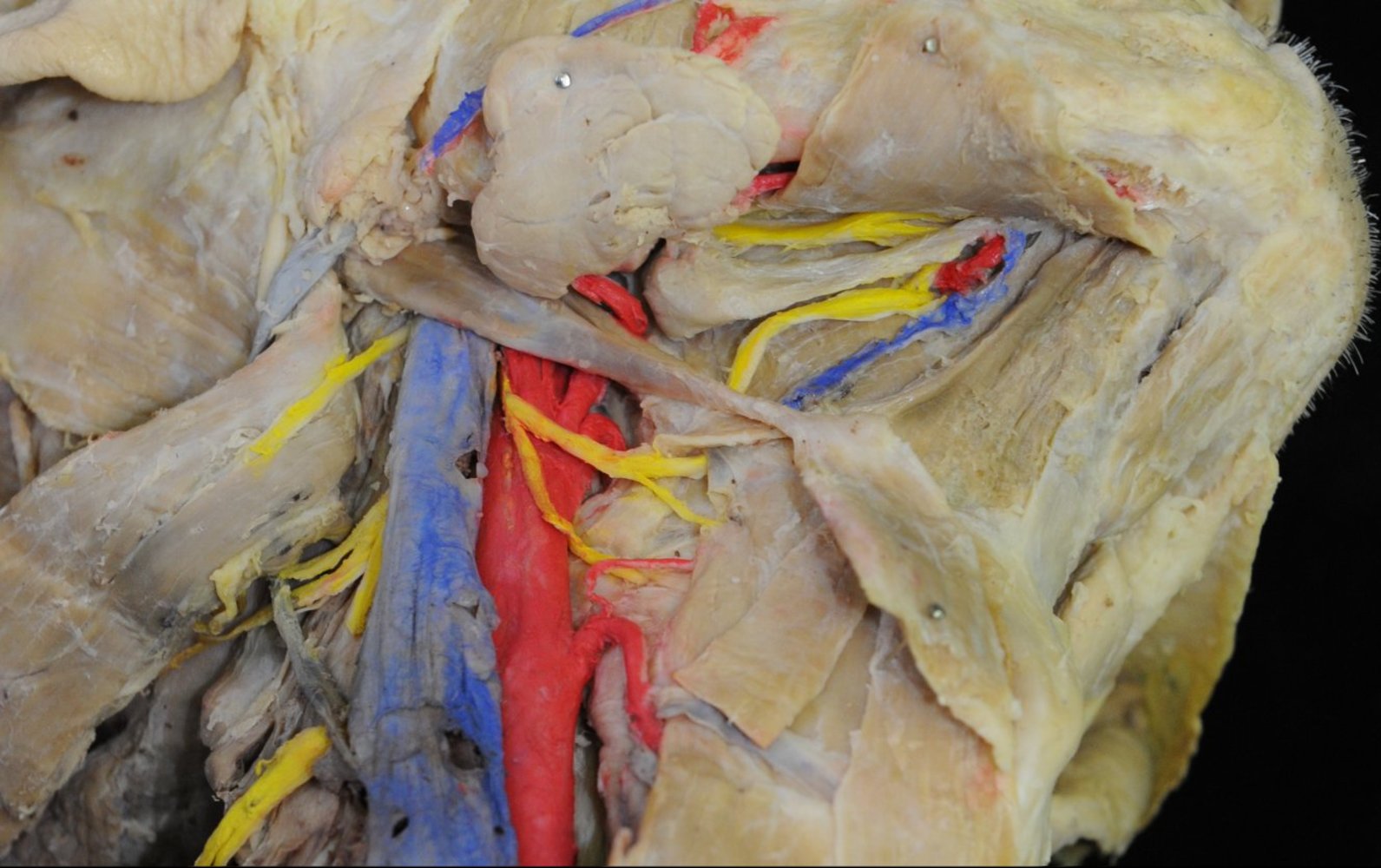
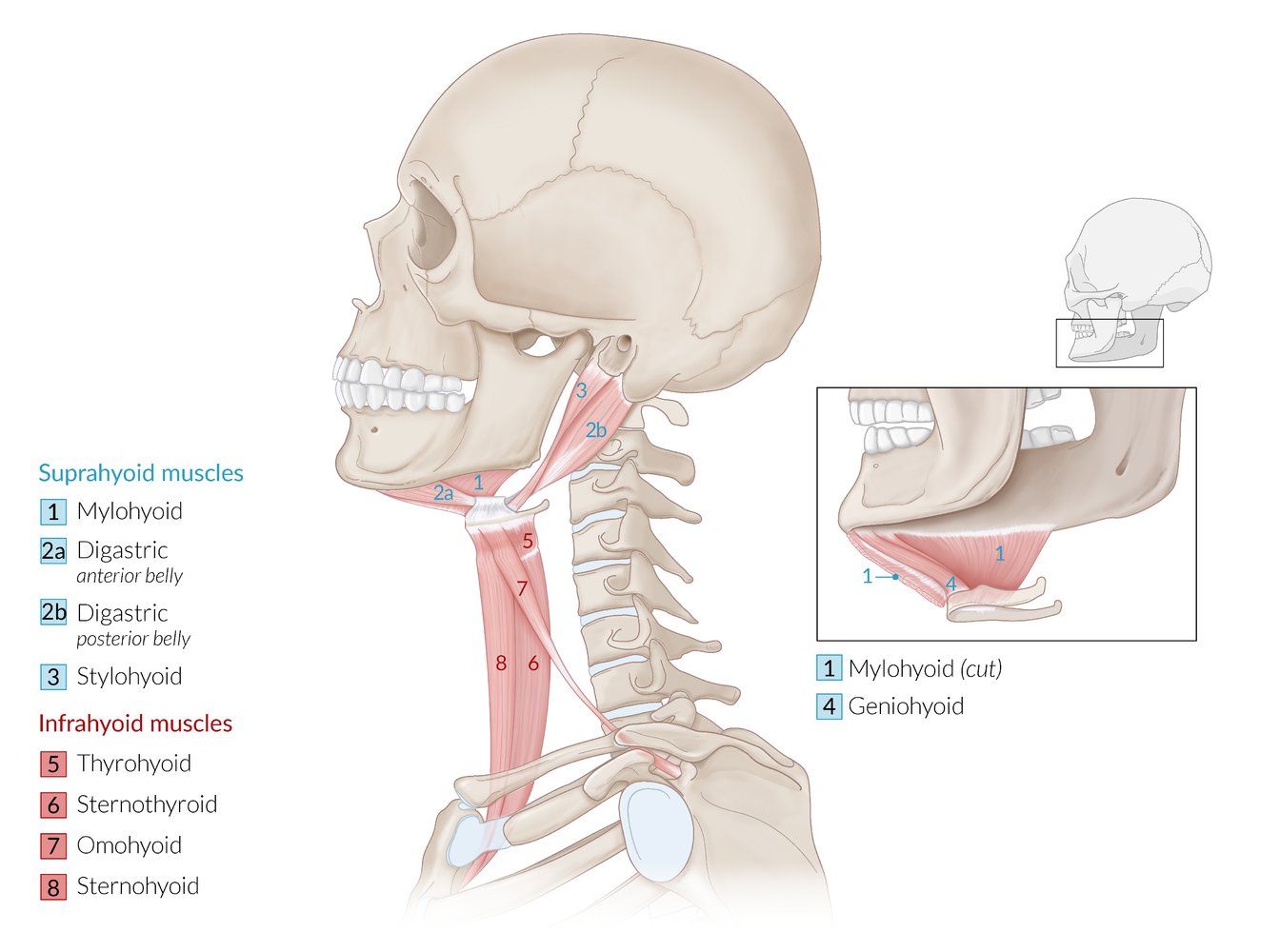
Hyoid bone and hyoid muscles
- The hyoid bone is a small U-shaped bone with two lesser horns (lateral) and two greater horns (posterior).
- It is positioned cranially to the thyroid cartilage and is connected to it via the thyrohyoid membrane.
- The hyoid muscles are distinguished into suprahyoid muscles (cranial to the hyoid bone) and infrahyoid muscles (caudal to the hyoid bone).
| Muscle | Function | Innervation | |||
|---|---|---|---|---|---|
| Suprahyoid muscles (Digastric, stylohyoid, mylohyoid, geniohyoid) |
|
|
|||
| Infrahyoid muscles (Sternohyoid, sternothyroid, thyrohyoid, omohyoid) |
|
|
|||
Neck muscles
The musculature of the neck can be differentiated into superficial and deep muscles.
Superficial muscles of the neck
| Muscle | Characteristics | Function | Innervation |
|---|---|---|---|
| Sternocleidomastoid |
|
|
|
| Platysma |
|
|
|
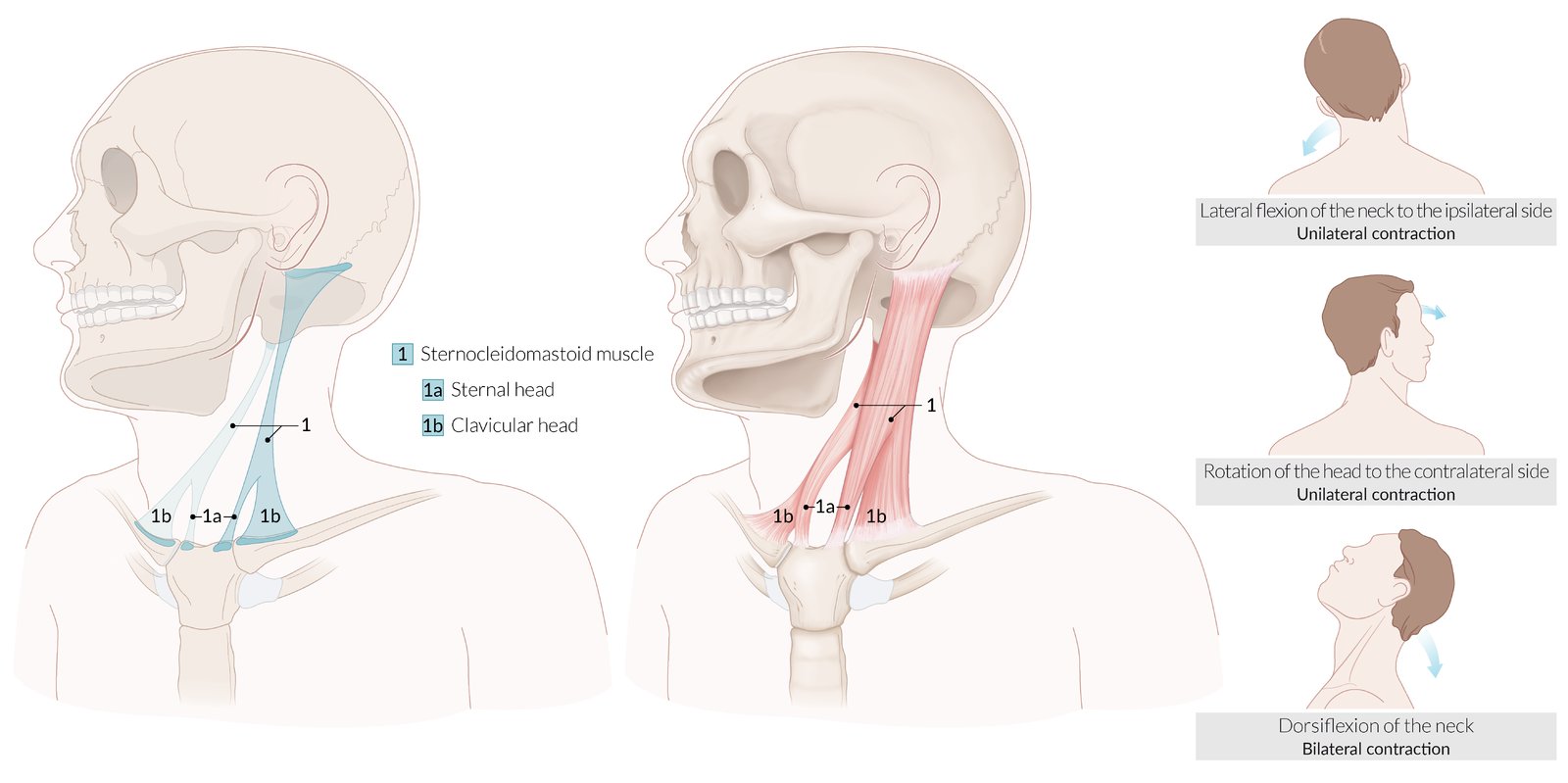
An abnormal tone or length of the sternocleidomastoid muscle has a variety of mechanisms (e.g., trauma, muscle tone disorders, congenital muscle tightness, extrinsic masses, ocular, etc.) and is referred to as torticollis (wry neck).
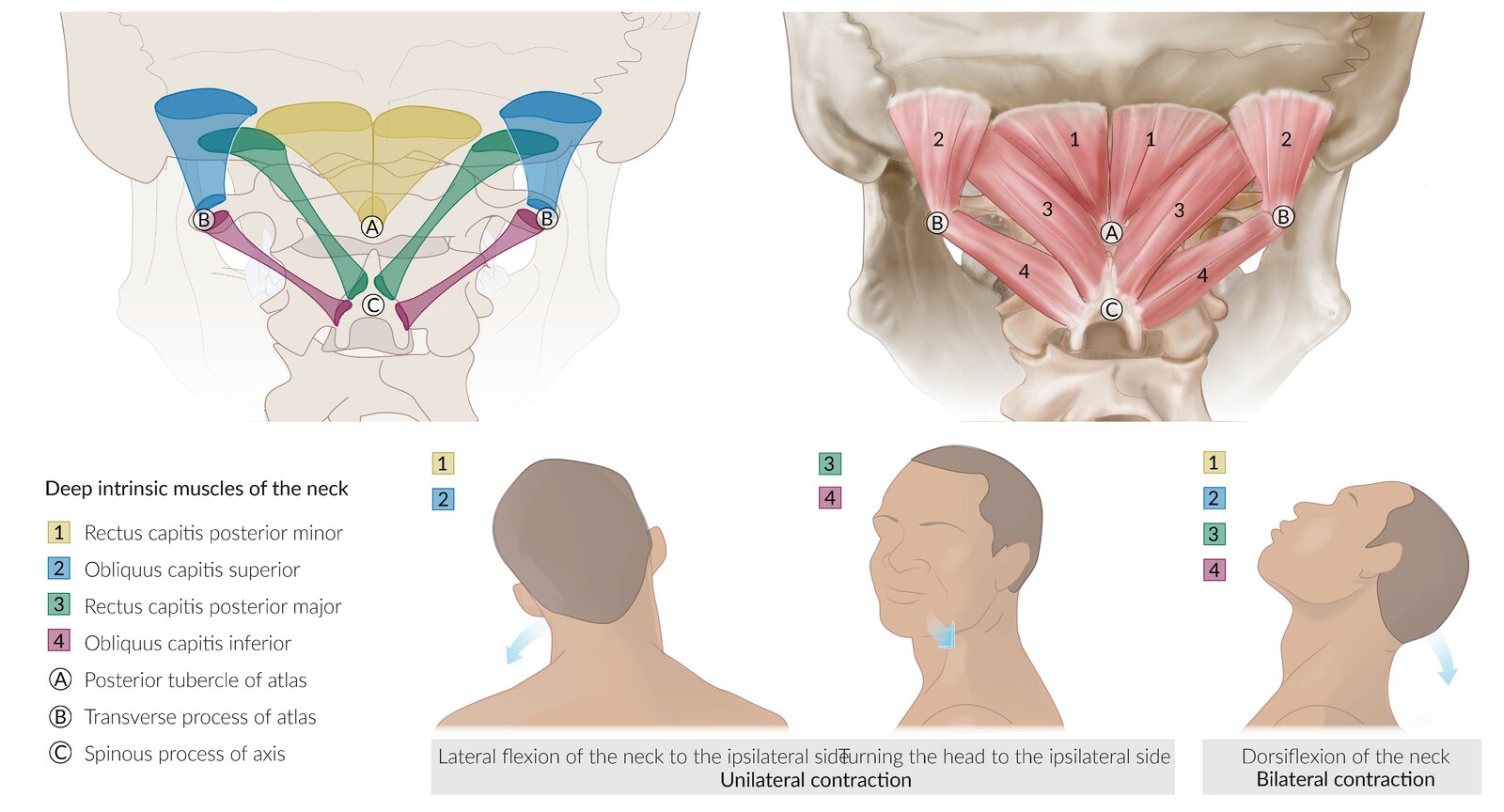
Deep muscles of the neck
- Move the cervical spine
- Partly act as accessory muscles for respiration
- Branches of the cervical plexus and brachial plexus innervate the deep neck muscles.
| Group | Origin | Insertion | Function | Innervation | |
|---|---|---|---|---|---|
| Scalene muscles | Anterior scalene |
|
|
|
|
| Middle scalene | |||||
| Posterior scalene | |||||
| Prevertebral muscles | Longus colli muscle |
|
|
|
|
| Longus capitis muscle |
|
|
|||
| Rectus capitis anterior |
|
||||
| Rectus capitis lateralis |
|
||||
| Suboccipital muscles | Obliquus capitis superior |
|
|
|
|
| Rectus capitis posterior minor |
|
|
|||
| Rectus capitis posterior major |
|
||||
| Obliquus capitis inferior |
|
||||

An abnormal position or insertion of the anterior or middle scalene muscle may result in compression of the brachial plexus and the subclavian vessels, causing thoracic outlet syndrome.
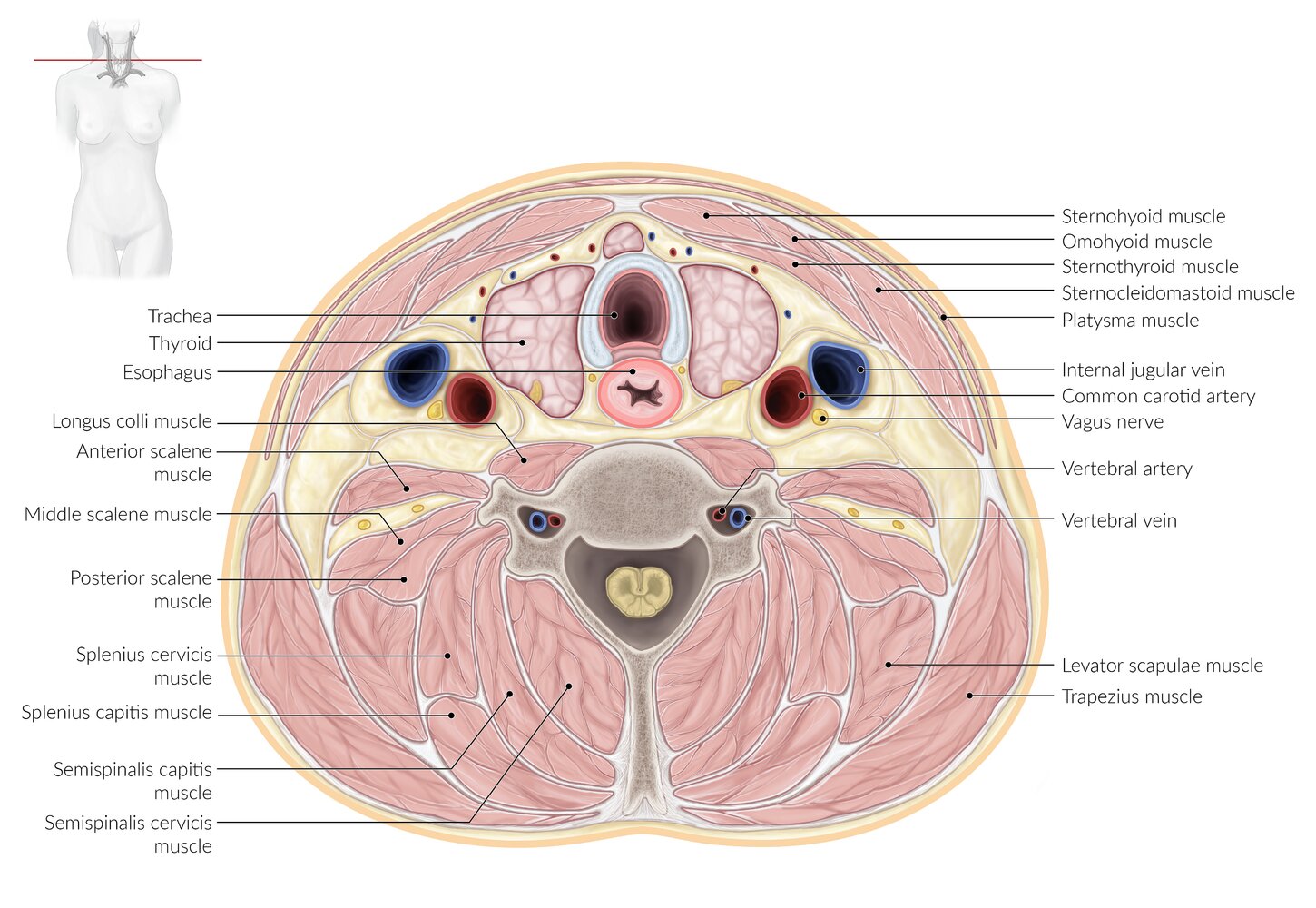
References:[1]
Fascias of the head
- Temporal fascia: covers temporal muscle
- Parotid fascia: covers the parotid gland
- Masseteric fascia: covers muscles of mastication
- Buccopharyngeal fascia: a layer of fascia that spans between the carotid sheaths, posterior to the esophagus and the lateral lobes of the thyroid gland
Muscles of facial expression do not have a fascia as they are placed directly under the skin.
Fascias of the neck
Because the structures in the neck region are very close to each other, there are many fasciae that ensheath and separate (compartmentalize) the different structures.
Superficial cervical fascia
- Position: lies between the skin and the deep cervical fascia
-
Surrounds:
- Subcutaneous fat tissue
- Platysma muscle
- Superficial nerves, veins, and lymph nodes
Deep cervical fascia
-
Investing layer
- Surrounds:
- Sternocleidomastoid muscle
- Trapezius muscle
- Position: directly under the platysma muscle
- Surrounds:
-
Carotid sheath
- Surrounds:
- Common carotid artery
- Internal carotid artery
- Internal jugular vein
- Vagus nerve
- Keeps the internal jugular vein open due to negative pressure
- Surrounds:
-
Pretracheal layer
- Surrounds:
- Esophagus
- Trachea
- Thyroid gland
- Infrahyoid muscles
- Surrounds:
-
Prevertebral layer
- Surrounds:
- Muscles
- Deep muscles of the neck
- Levator scapulae muscle
- Intrinsic muscles of the neck
- Vasculature and nerves
- Sympathetic trunk
- Brachial plexus
- Subclavian artery
- Phrenic nerve
- Muscles
- Attachment
- Cranially: occipital bone
- Caudally: merges with the endothoracic fascia and the anterior longitudinal ligament
- Surrounds:
The prevertebral layer of the deep cervical fascia extends from the skull via the mediastinum to the diaphragm. Therefore, infections in this layer can cause great harm.

Arteries
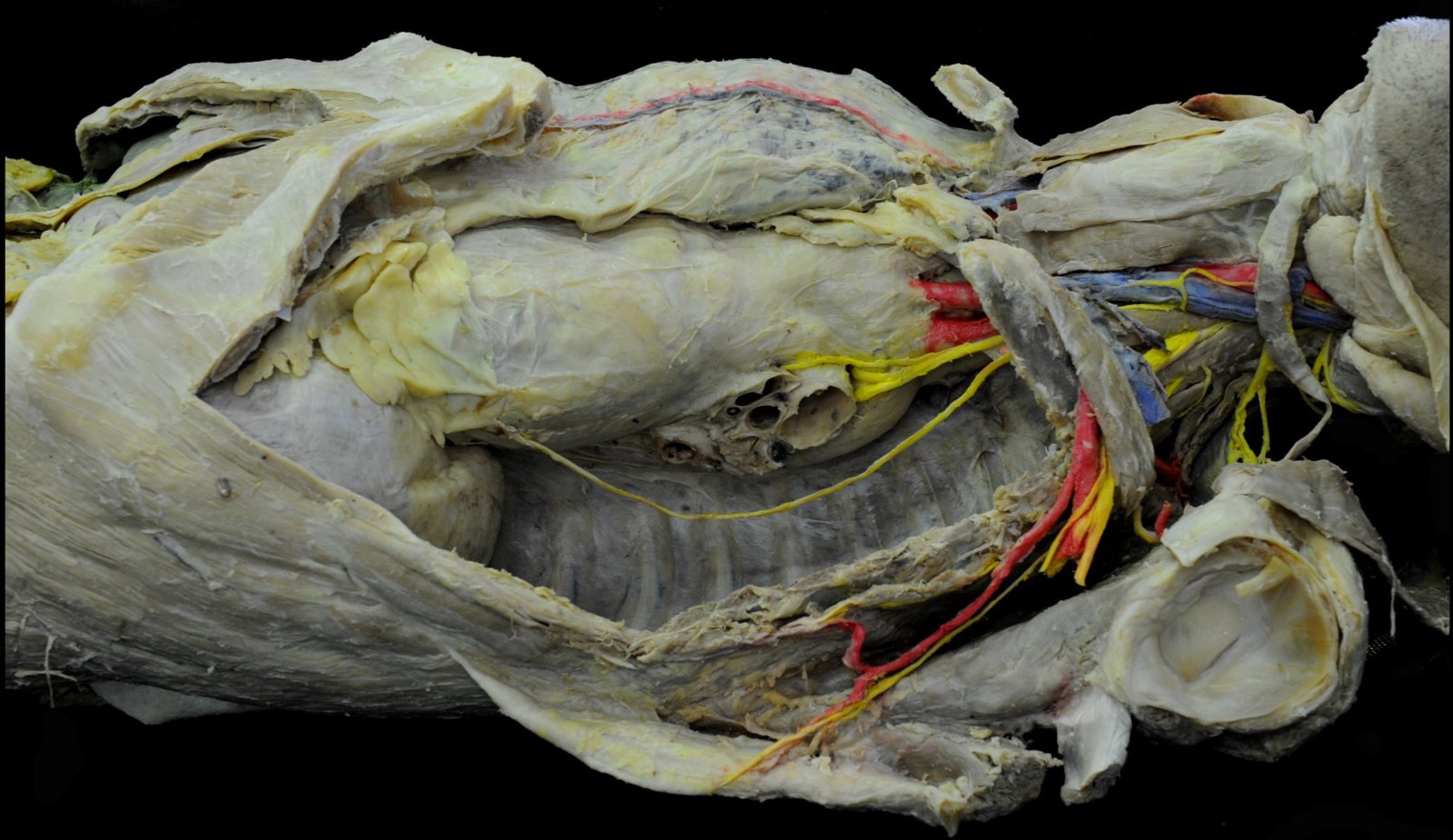
- The common carotid arteries and subclavian arteries supply the head and neck.
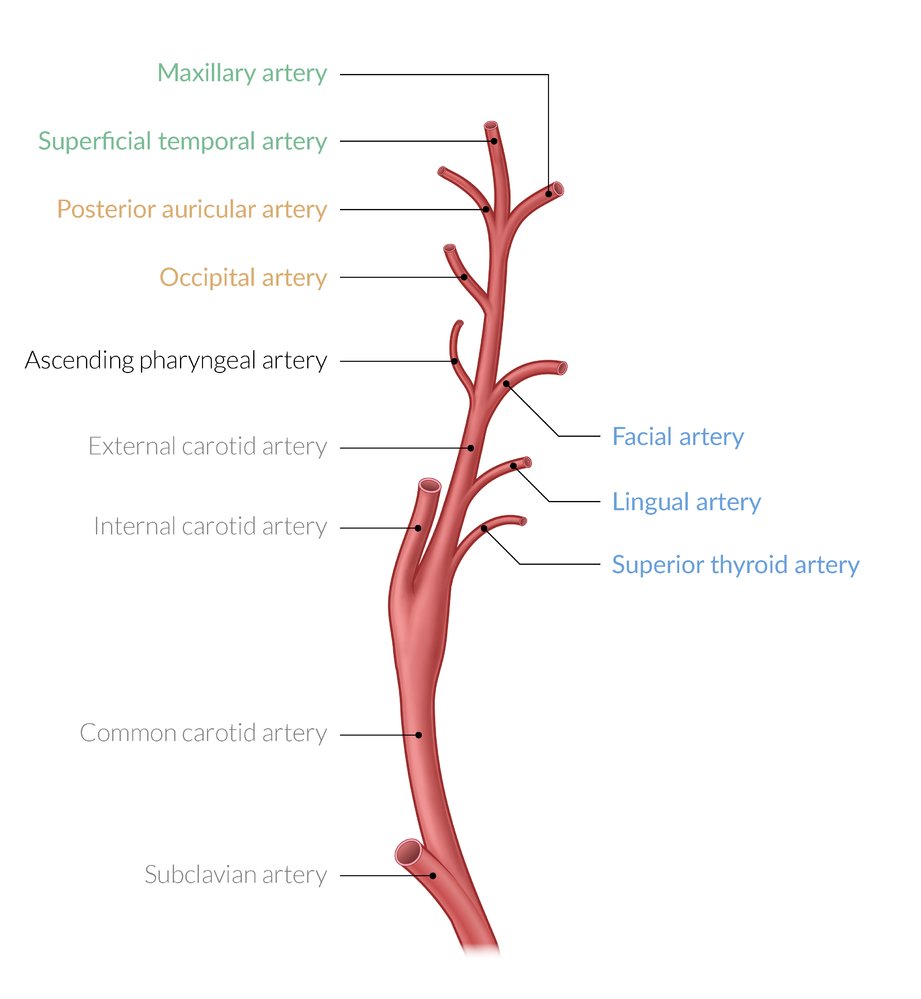
- The common carotid artery splits into the internal carotid artery, supplying mainly intracranial regions, and the external carotid artery, supplying mainly extracranial regions.
- The subclavian artery supplies the lower regions of the neck, close to the thorax.
Subclavian artery

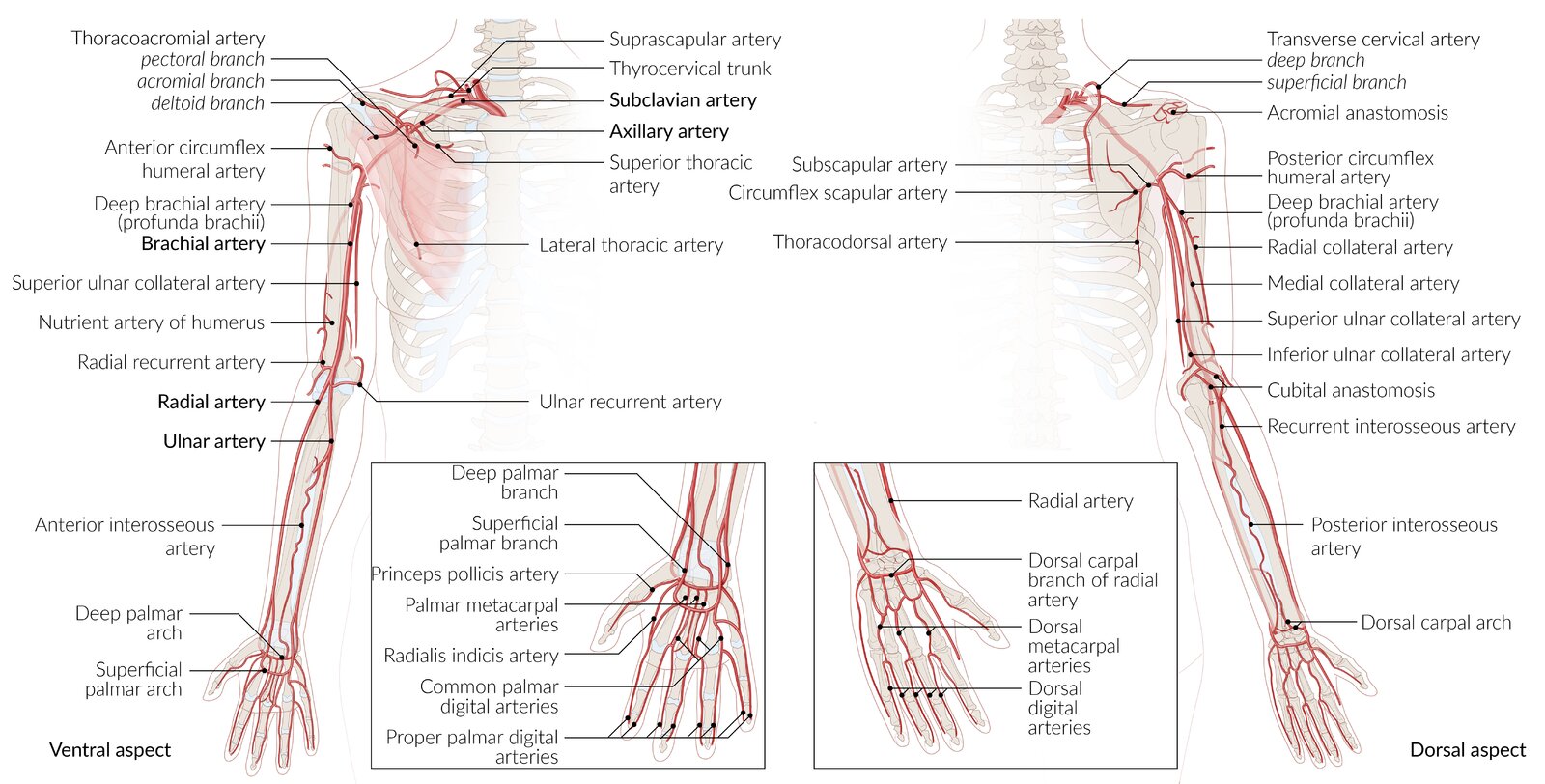
-
Origin
- Left subclavian artery: direct branch of the aorta
- Right subclavian artery: a branch from the brachiocephalic artery
-
Branches
- Internal thoracic artery
- Vertebral artery
- Thyrocervical trunk
- Costocervical trunk
In stenosis of the coronary arteries, the internal thoracic artery can be used as a natural coronary artery bypass graft.
A stenosis of the subclavian artery proximal to the origin of the vertebral artery may result in subclavian steal syndrome.
Common carotid arteries

-
Origin
- Left side: direct branch of the aorta
- Right side: a branch from the brachiocephalic artery
- Course: ascend in the neck within the carotid sheath
-
Branches on each side: form the carotid bifurcation at the level of C4
- Internal carotid artery
- External carotid artery
The common carotid arteries bifourcate at the level of C4.
An increased carotid sinus sensitivity can result in syncopes due to low systolic blood pressure when pressure is applied to the carotid sinus. It is frequently associated with arteriosclerotic changes in the carotid sinus.
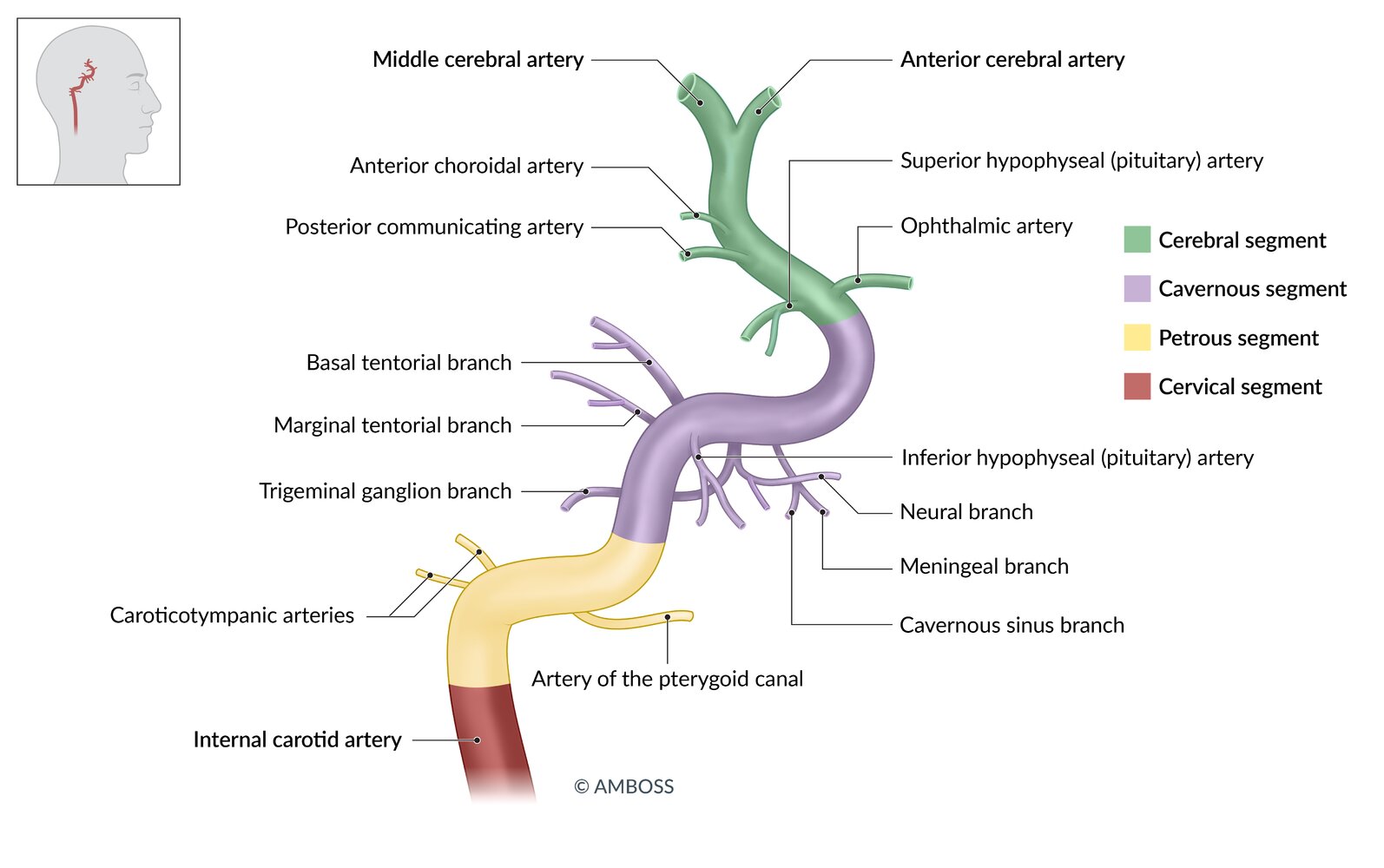
Internal carotid artery
- Origin: arises from the common carotid at the level of the upper border of the thyroid cartilage
- Course: enters the skull via the carotid canal of the temporal bone
-
Branches
- Ophthalmic artery
- Anterior cerebral artery
- Middle cerebral artery
- Circle of Willis
- No branches in the neck
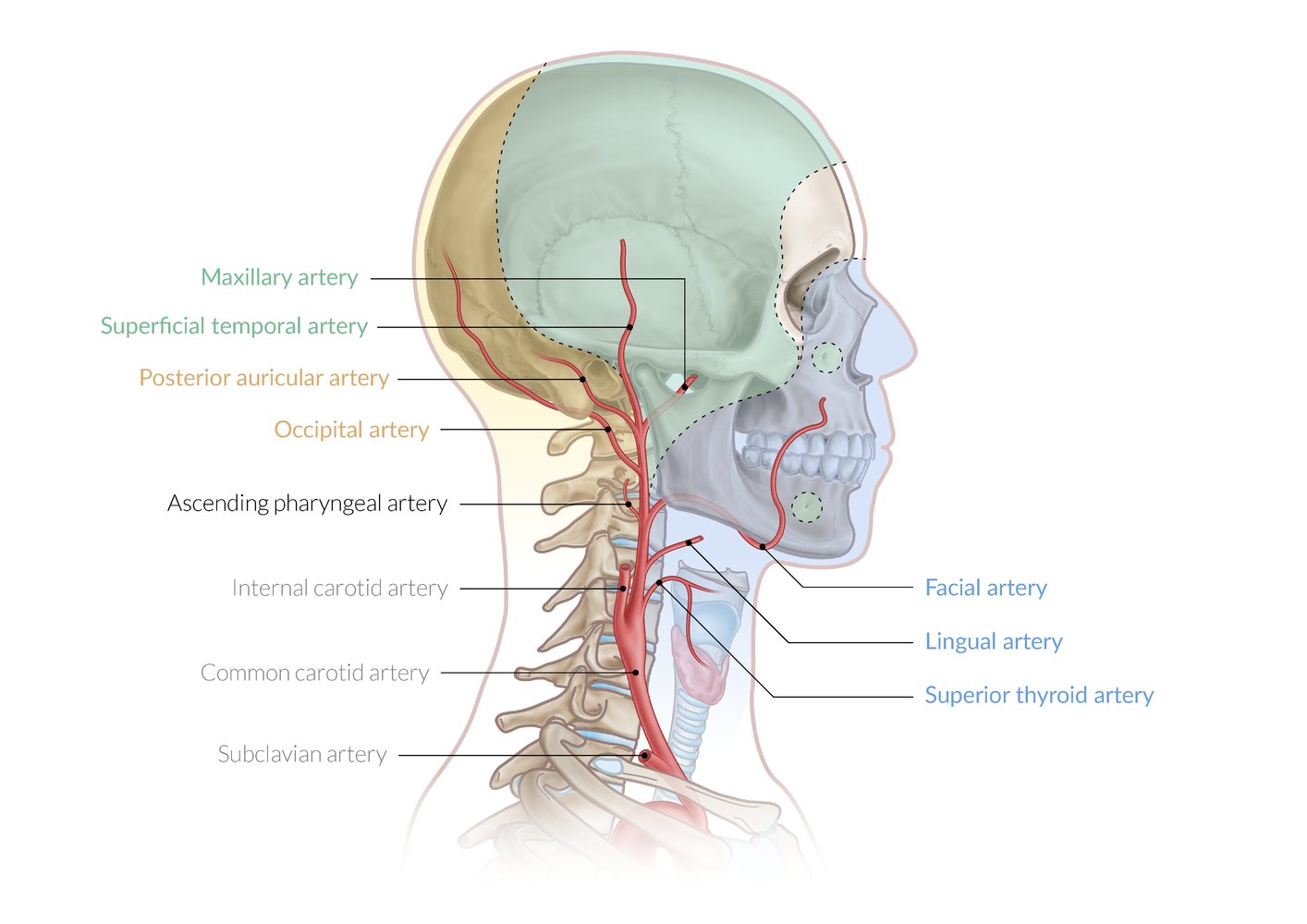
External carotid artery
- Origin: arises from the common carotid at the level of the upper border of the thyroid cartilage
-
Branches
- Superior thyroid artery
- Lingual artery
- Facial artery
- Ascending pharyngeal artery
- Occipital artery
- Posterior auricular artery
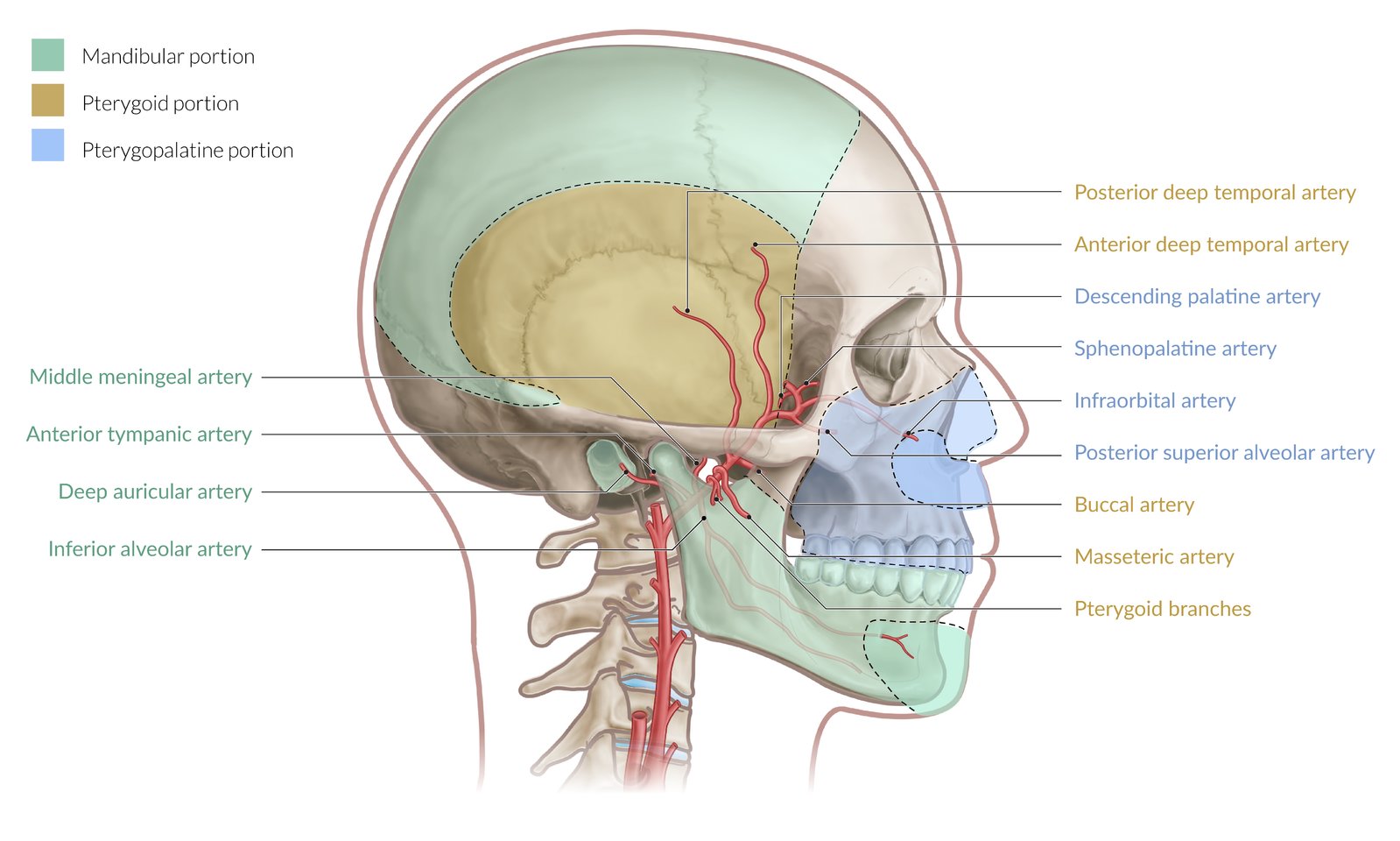
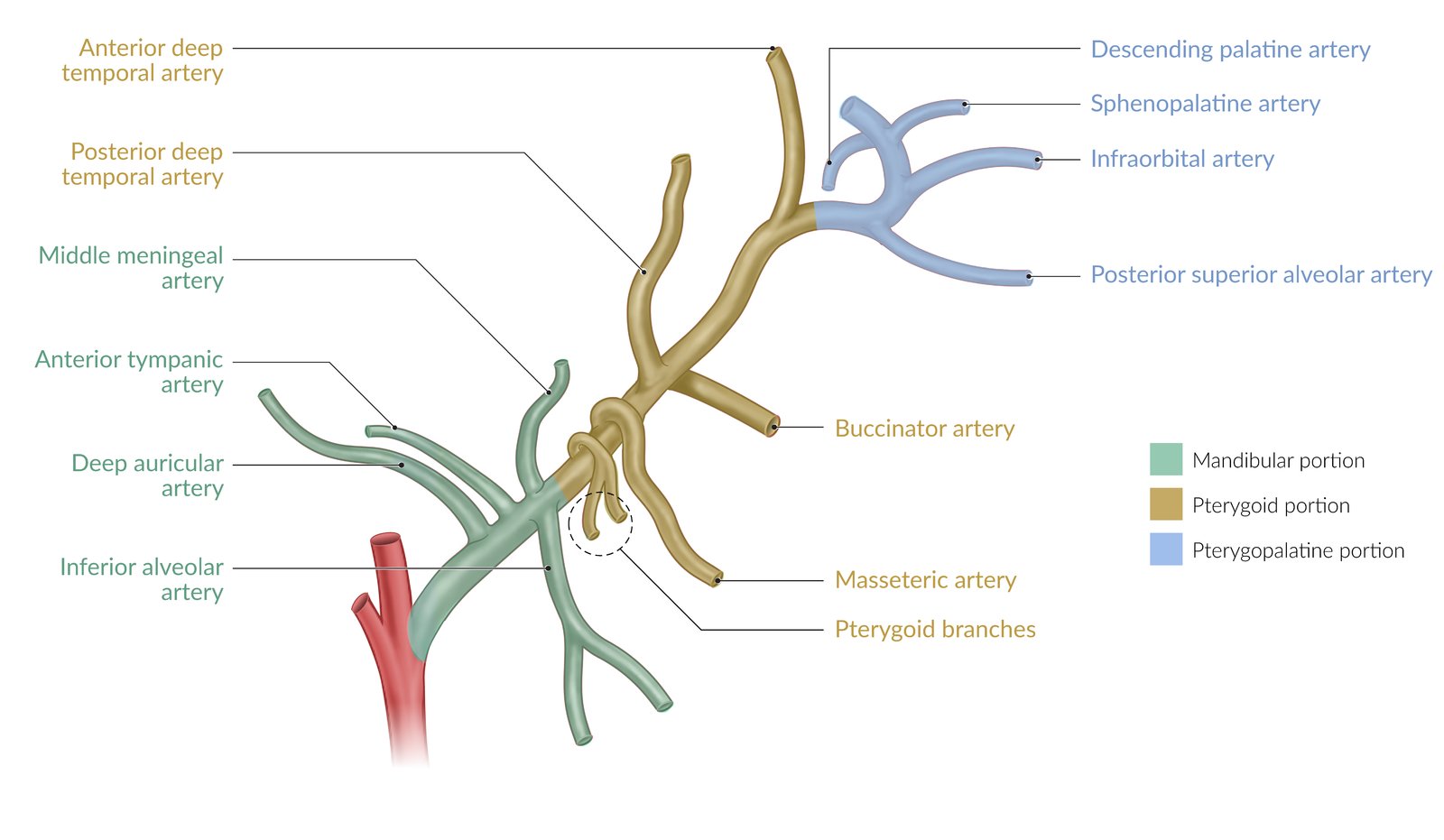
- Maxillary arteries
- Superficial temporal artery
The temporal artery is involved in giant cell arteritis.
A branch of the maxillary artery is the middle meningeal artery. It enters the skull through the foramen spinosum and mostly supplies the meninges and the skull. A craniocerebral injury can result in rupture or laceration of the middle meningeal artery, leading to the life-threatening condition of an epidural hematoma.
Veins
Superficial veins
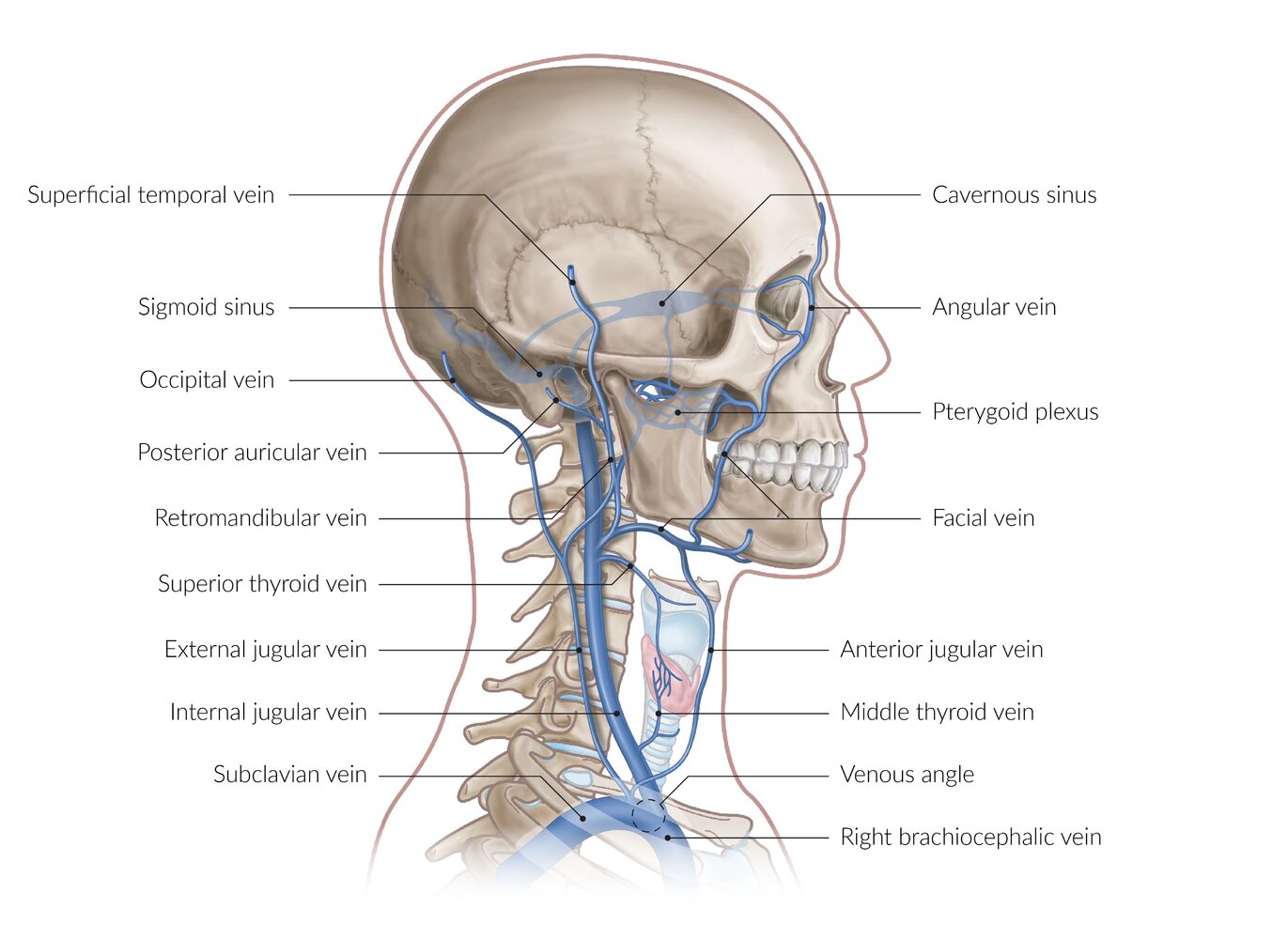
External jugular vein
- Collects blood from the exterior cranium and parts of the face
- Begins at the parotid gland and extends downwards
- Runs along the side of the neck
- Covered by the platysma
- Pierces through the superficial layer of the fascia of the neck
- Ends in the venous angle or in the internal jugular vein
Deep veins
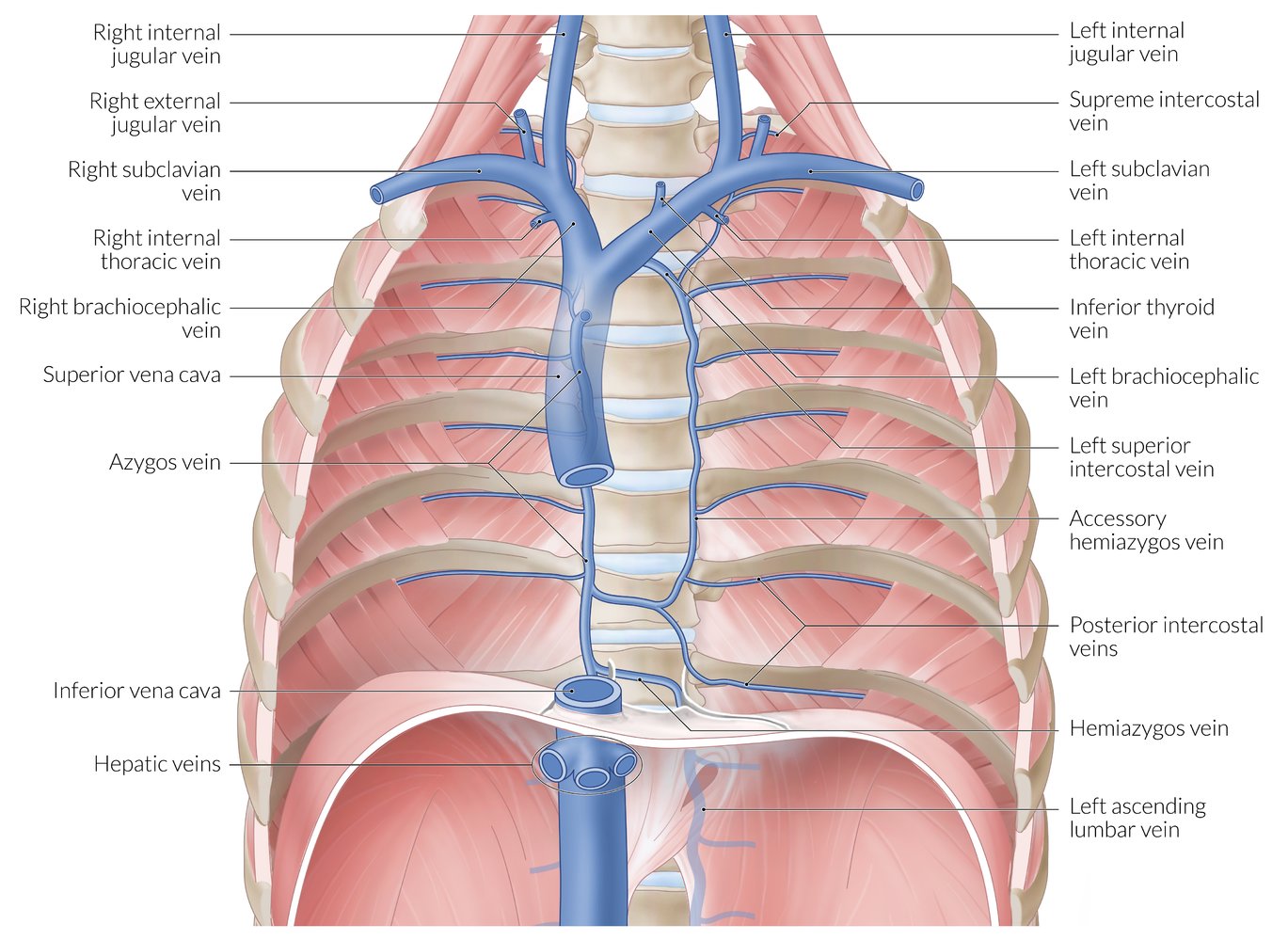
Internal jugular vein
- Collects blood from the brain, parts of the face, and neck
- Continuation of the sigmoid sinus at the jugular foramen
- Begins at the base of the skull and extends downwards
- Ends in the brachiocephalic vein → superior vena cava
Subclavian vein
- Drains venous blood from the arms
- Runs along the front of the anterior scalene muscle (anteriomedial to the scalene triangle)
- Ends in the venous angle, where it forms the brachiocephalic vein with the internal jugular vein

Lymphatics
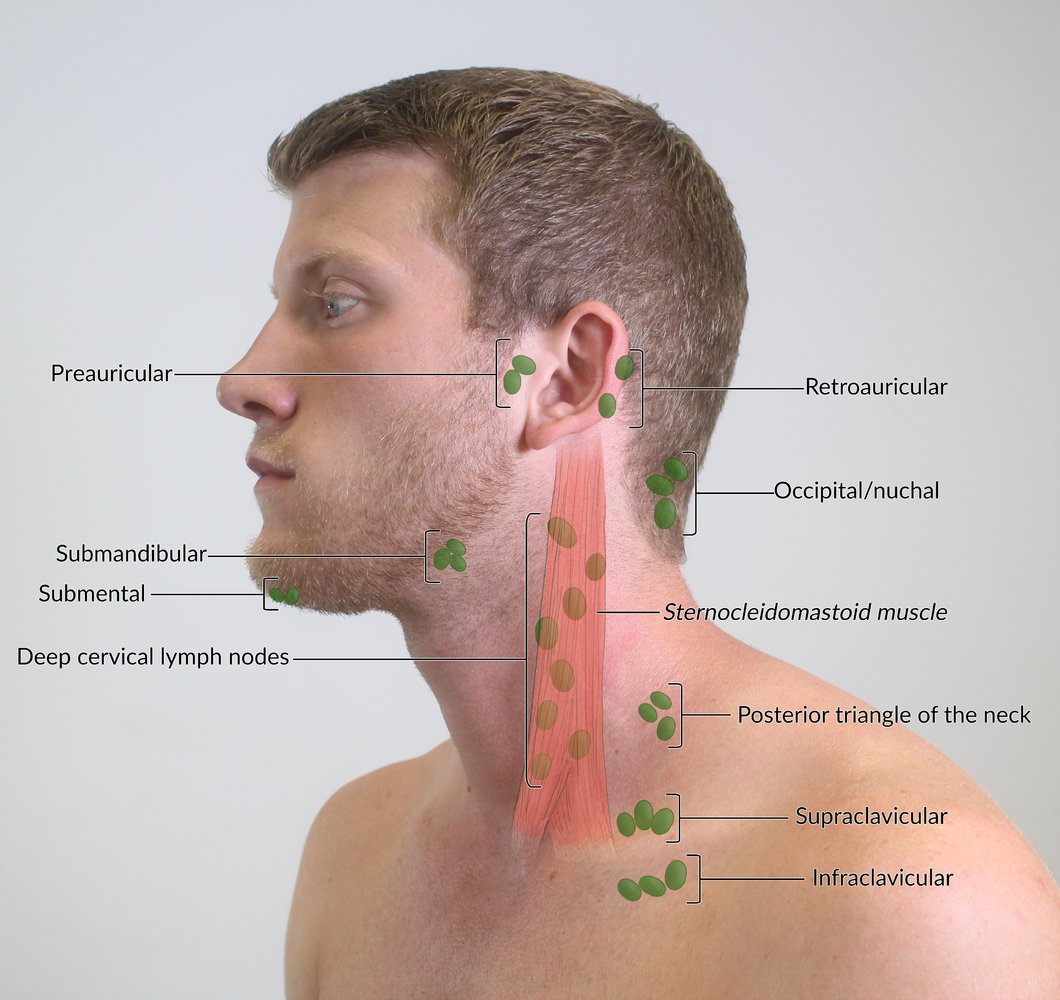
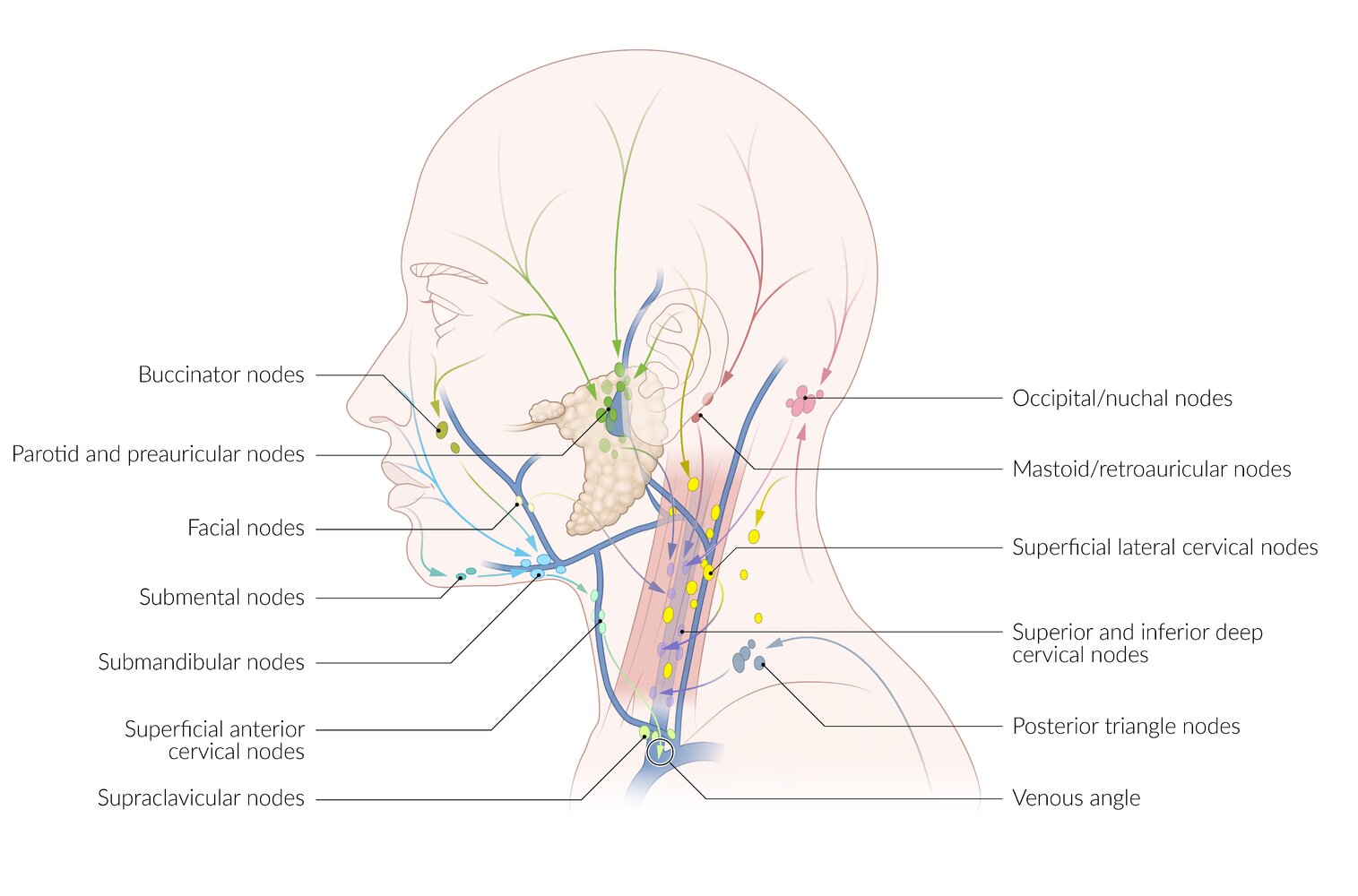
- About one-third of the lymph nodes of the body are located in the head and neck area as the beginning of the respiratory and digestive tract is prone to many pathogens.
- All lymphatic drainage ends in the left and right jugular lymph trunk.
- On the right side, this trunk ends in the junction of the internal jugular and subclavian veins, called the venous angle.
- On the left side, it joins the thoracic duct.
- For details, see “Lymph nodes of the head and neck.”
| Characteristics | ||
|---|---|---|
| Superficial cervical lymph nodes |
|
|
| Deep cervical lymph nodes | Superior |
|
| Inferior |
|
|
Nerves
- Nerves of the head and neck region include:
- Cranial nerves (see cranial nerve disorders)
- Parasympathetic cervical ganglia
- Sympathetic cervical ganglia (see autonomic nervous system for more details)
- Branches of the spinal nerves
- The ventral branches of the spinal nerves (C1–C4) form the cervical plexus and have sensory and motor branches.
Cervical plexus

Description: A nerve plexus composed of the anterior rami of the cervical nerve roots, which provides motor and sensory innervation to most neck muscles and the area over the anterior and lateral neck.
| Nerve | Spinal segment | Innervation |
|---|---|---|
| Ansa cervicalis | C1–C3 |
|
| Phrenic nerve | C3–C5 |
|
| Lesser occipital nerve | C2, C3 |
|
| Great auricular nerve | C2, C3 | |
| Transverse cervical nerve | C2, C3 | |
| Supraclavicular nerve | C3, C4 | |
| Posterior branches of cervical nerves Suboccipital nerve, Greater occipital nerve, Third occipital nerve | C1–C3 |
|
Phrenic nerve: C3, C4, C5 – keep the diaphragm alive!
A mediastinaltumor can present with shortness of breath, shoulder pain, and hiccups due to irritation of the phrenic nerve.
References:[1]
Many structures in the head and neck have their origin in the pharyngeal arches, pharyngeal pouches, and pharyngeal grooves. For a detailed description of these see branchial apparatus.
Head
- Diseases of salivary gland
- Sinusitis
- Otitis externa
- Acute otitis media
- Chronic otitis media
- Hearing loss
- Diseases of retina
- Facial nerve palsy
Neck
- Diseases of salivary gland
- Goiter
- Thyroid nodules
- Thyroid cancer
- Thoracic outlet syndrome
- Laryngitis
- Acute tonsillitis
- Pharyngitis, see: differential diagnosis of tonsillitis
- Clinical assessment of central venous pressure