Hypoparathyroidism is an endocrinological disorder characterized by parathyroid hormone (PTH) deficiency. The most common cause of hypoparathyroidism is damage or injury to the parathyroid glands during anterior neck surgery, which leads to impaired PTH synthesis and/or secretion. Other causes include genetic conditions and autoimmune or infiltrative parathyroid gland destruction. Congenital disorders affecting parathyroid gland development typically manifest in childhood. Pseudohypoparathyroidism manifests similarly to hypoparathyroidism but is caused by resistance to PTH rather than insufficient hormone levels. Hypocalcemia is the primary manifestation of both hypoparathyroidism and pseudohypoparathyroidism, and can cause symptoms ranging from muscle cramps to seizures or heart failure. Chronic hypoparathyroidism can cause basal ganglia calcifications (resulting in extrapyramidal disorders), cataracts, and skeletal and dental abnormalities. The presence of hypocalcemia and concurrent low (or inappropriately normal) PTH levels on two separate occasions ≥ 2 weeks apart confirms the diagnosis. Management typically includes correcting hypocalcemia through calcium and vitamin D supplementation and monitoring for complications. PTH replacement therapy may be indicated in selected patients.
- Postoperative: most commonly occurs as the result of accidental injury to parathyroids (or their blood supply) during thyroidectomy, parathyroidectomy, or radical neck dissection
- Autoimmune: : second most common cause
-
Nonautoimmune destruction
- Infiltration of parathyroid gland
- Wilson disease
- Hemochromatosis
- Granulomas
- Metastases
- Radiation-induced destruction
- Gram-negative sepsis
- Toxic shock syndrome
- HIV infection
- Infiltration of parathyroid gland
-
Congenital
- Parathyroid glandaplasia or hypoplasia (DiGeorge syndrome)
- PTH gene mutation
- Autosomal dominant hypocalcemia
- Functional hypoparathyroidism: caused by hypermagnesemia or hypomagnesemia (reversible) [1]
Consider hypoparathyroidism in patients who present with hypocalcemia after surgery for head and neck cancer, e.g., thyroidectomy. [2]
Acute manifestations [3]
-
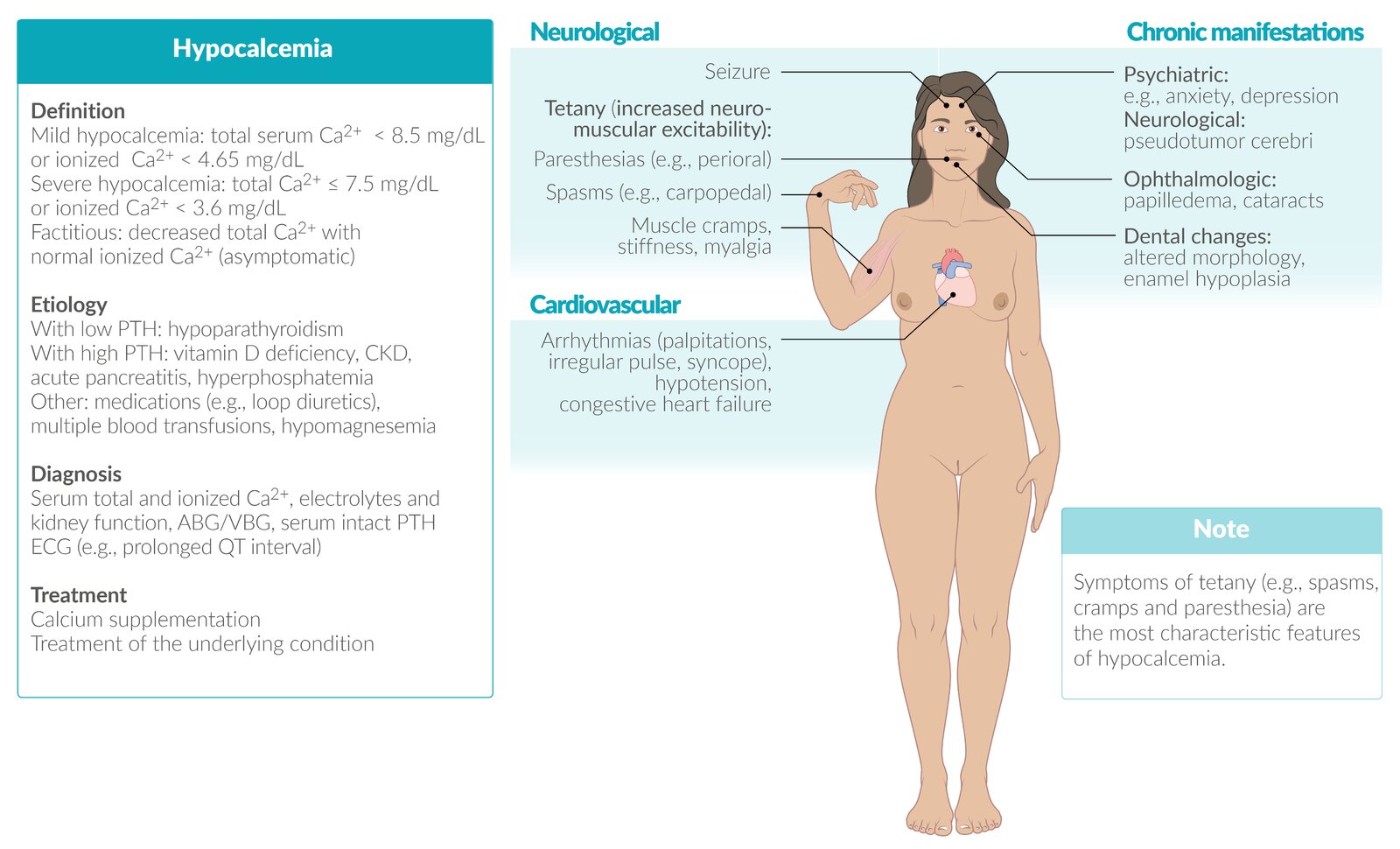
Clinical features of hypocalcemia, e.g.:
- Neurological: tetany, laryngospasm, seizures
- Cardiac: arrhythmias
The presence of the Chvostek sign or Trousseau sign in response to provocative maneuvers may help to identify latent tetany in patients with asymptomatic hypocalcemia. [4]
Chronic manifestations
-
Extrapyramidal disorders
- Parkinsonism
- Dystonia
- Hemiballismus
- Choreoathetosis
- Oculogyric crises
- Dementia
-
Ocular disease
- Cataracts
- Keratoconjunctivitis
-
Skeletal manifestations
- Increased bone mineral density
- Osteosclerosis
-
Dental abnormalities
- Dental hypoplasia
- Failure of tooth eruption
- Defective root formation
- Cutaneous manifestations: dry, puffy, coarse skin
Assess for hypoparathyroidism in patients with confirmed hypocalcemia and all patients after total thyroidectomy.
Laboratory studies [1]
Diagnostic confirmation
Both results must be present on two separate occasions, ≥ 2 weeks apart. [5]
- Serum calcium: below the LLN
- Serum intact PTH: low or inappropriately normal
Calcium levels respond to changes in PTH levels within minutes. To ensure accurate results, perform calcium and PTH studies concurrently.
Severe hypocalcemia is a medical emergency. Do not wait for confirmation of the underlying etiology to initiate treatment of hypocalcemia.
Additional studies [6]
The following findings help support the diagnosis, monitor for complications, and guide management.
-
Blood tests
- Phosphate: typically elevated
- 1,25-dihydroxyvitamin D (1,25[OH]2D): normal or low (due to reduced renal production) [7]
- 25-hydroxyvitamin D (25[OH]D): normal
- Magnesium: to assess for functional hypoparathyroidism
- Creatinine: Elevated levels suggest renal dysfunction, which is a common complication.
- Urine Ca/Cr clearance ratio: typically elevated
-
Genetic testing: Obtain for patients with nonsurgical hypoparathyroidism and any of the following
- Age < 40 years
- Family history of nonsurgical hypoparathyroidism
- Syndromic pattern (e.g., features of autoimmune polyendocrine syndrome type 1)
Renal imaging [1]
- Assess for nephrocalcinosis and nephrolithiasis at the time of diagnosis.
- Options include CT abdomen or renal ultrasound.
Postthyroidectomy assessment [1]
- Measure serum PTH levels 12–24 hours after total thyroidectomy.
- Interpretation [1]
- PTH < 10 pg/mL (1.05 pmol/L): Permanent hypoparathyroidism is possible.
- PTH > 10 pg/mL (1.05 pmol/L): Permanent hypoparathyroidism is unlikely.
See “Interpretation of laboratory findings in hypocalcemia.”
Pseudohypoparathyroidism type 1A (PHP1A)
- Definition: end-organ (i.e., bones and kidneys) resistance to parathyroid hormone (PTH) despite sufficient PTH synthesis due to a defective Gs protein α subunit
-
Inheritance
- Autosomal dominant
- Inherited from the mother (GNAS gene imprinting)
- Pathophysiology: mutations in GNAS1 → impaired encoding of α subunit → missing activation of adenylate cyclase when PTH binds to Gs → resistance to PTH in kidney and bone tissue
-
Clinical features
-
Albright hereditary osteodystrophy (AHO)
- Round face
- Short stature
- Obesity
- Brachydactyly of the 4th and 5th fingers
- Intellectual disability
- Subcutaneous ossifications
-
Symptoms related to low calcium and high phosphate levels
- Seizures
- Numbness, tetany
- Cataracts
- Dental problems
-
Albright hereditary osteodystrophy (AHO)
-
Diagnostics
- Persistent hypocalcemia despite ↑ PTH levels
- ↑ Phosphate levels
Pseudopseudohypoparathyroidism
- Definition: extremely rare condition that mimics PHP1A but without end-organ resistance to PTH
-
Inheritance
- Autosomal dominant
- Defective Gs protein α subunit is inherited from the father (GNAS gene imprinting).
- The normal allele from the mother allows for maintaining the responsiveness of the kidneys to PTH.
- Clinical features: Albright hereditary osteodystrophy
- Diagnostics: normal calcium, PTH, and phosphate
The differential diagnoses listed here are not exhaustive.
All patients should receive conventional therapy with calcium and vitamin D supplementation. Refer to an endocrinologist for definitive management.
Treatment of hypocalcemia [2]
-
Indications for urgent calcium repletion include:
- Severe hypocalcemia
- Symptoms of hypocalcemia
- ECG findings of hypocalcemia
-
Agents
- Calcium gluconate OR calcium chloride
- See “Repletion regimens for hypocalcemia” for dosages.
- Disposition: hospital admission for cardiac monitoring if IV calcium repletion is indicated
Pharmacotherapy [1][7]
Therapeutic regimens are adjusted and dosages titrated to achieve target serum levels.
-
Vitamin and mineral supplementation: indicated for all patients
- Calcium (e.g., calcium carbonate or calcium citrate): target serum calcium at or slightly below the LLN
- Vitamin D (e.g., cholecalciferol, ergocalciferol, or calcitriol): to maintain serum 25[OH]D level above 20–30 ng/dL [7]
- Magnesium (e.g., magnesium oxide): to maintain normal serum magnesium levels
-
PTH replacement therapy (subcutaneous recombinant human PTH 1–84)
- Indicated in patients with inadequate serum calcium control and/or adverse effects from conventional therapy
- Can be given in addition to, or instead of, conventional therapy
- Decreases calcium and vitamin D supplementation needs, and reduces serum phosphate and urine calcium levels
-
Thiazide diuretics
- Reduce hypercalciuria; may prevent nephrocalcinosis
- Require adherence to a low-sodium diet and careful monitoring of blood pressure and electrolytes
Monitoring [1]
Regular follow-up studies facilitate early identification of complications.
- Patients on stable therapy: serum creatinine, calcium, magnesium, and phosphate levels every 3–12 months
- Within days of a significant change in treatment: serum calcium level